


How often should Pallet Racking be inspected? 3 checks to know
In Australia, a pallet might hold 100 cartons of 24 cans or 128 cartons of 16 cans, depending on the packaging and stacking arrangement. Whether you’re managing a brewery, warehouse or distribution centre, knowing these numbers can make storage and delivery planning much easier.
How many Cartons of Beer fit on a pallet in Australia?
The number of beer cartons on a pallet depends on carton dimensions, pack size and stacking height. For a practical example, Australian brewery Shelter Brewing Co. has published the following pallet configurations:
| Beer Carton Format | Cartons per Layer | Layers | Total Cartons |
| 24 × 375 mL cans (Shelter Lager) | 10 | 10 | 100 |
| 16 × 375 mL cans (Shelter Summer Sour) | 16 | 8 | 128 |
These are published examples, not fixed capacities for every Australian beer brand or pallet. Interestingly, more cartons don’t always mean more beer. A pallet of 100 cartons containing 24 cans holds 2,400 cans, while 128 cartons containing 16 cans holds 2,048 cans.
That’s why checking the pack size matters just as much as counting cartons.
Read more: How often should Pallet Racking be inspected? 3 checks to know
What is the standard Beer Pallet size in Australia?
Most Australian distribution networks use the standard pallet footprint of 1,165 × 1,165 mm. A standard CHEP Australian pallet is also approximately 150 mm high.
This square design provides a consistent base for stacking cartons and moving goods between breweries, warehouses and retailers. However, pallet dimensions vary internationally:
| Pallet Type | Dimensions |
| Australian Standard Pallet | 1,165 × 1,165 mm |
| European Pallet (EUR) | 1,200 × 800 mm |
| North American Standard Pallet | 1,219 × 1,016 mm (48 × 40 inches) |
Different pallet sizes provide different usable surfaces. So, a stacking arrangement designed for an American pallet may not work the same way on an Australian one. Before planning a beer shipment, check which pallet size your supplier or logistics provider uses.
What affects the number of Beer Cartons per Pallet?
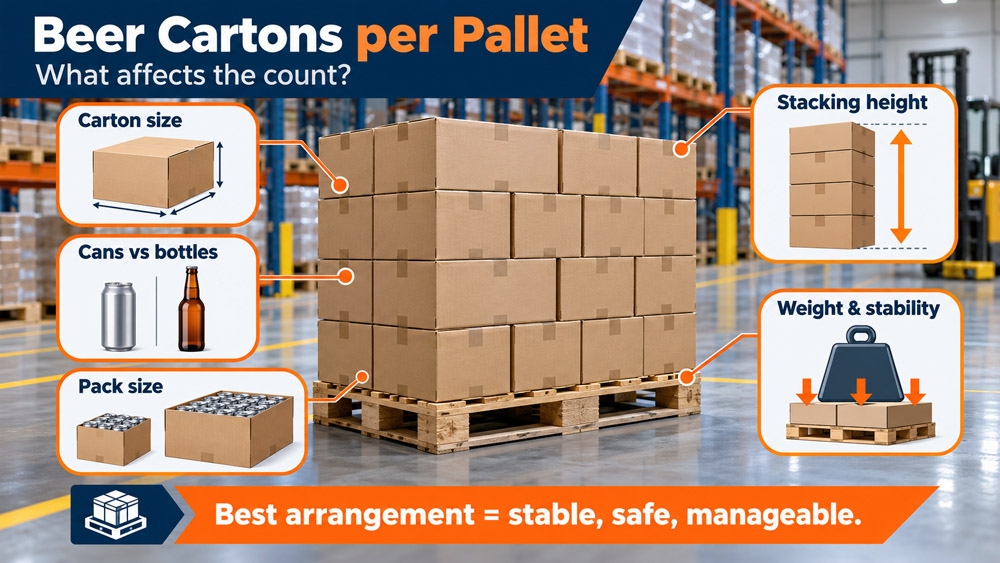
Even when two breweries use identical pallets, their carton counts can differ considerably. Several factors influence how much beer can be stacked:
- Carton dimensions: Larger boxes take up more space, reducing the number that fit on each layer.
- Cans vs bottles: Glass bottles are generally heavier and may require additional protective packaging.
- Pack size: A 16-pack carton and a 24-pack carton have different dimensions and stacking arrangements.
- Stacking height: Warehouse clearance, transport requirements and carton strength determine how high cartons can be stacked.
- Weight and stability: A pallet must remain stable and within its rated capacity, even when more cartons could physically fit.
Ultimately, the best arrangement isn’t always the one with the highest carton count. It’s the one that keeps the load stable and manageable during handling, transport and storage.
How to calculate Beer Cartons per Pallet
You don’t need complicated calculations to estimate how many cartons will fit. Start with three simple steps.
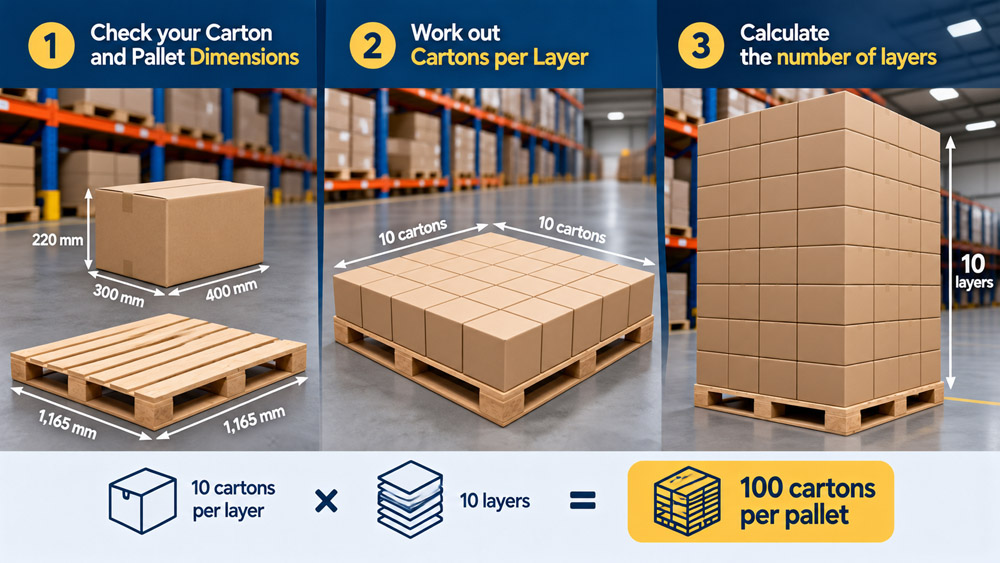
Step 1: Check your Carton and Pallet Dimensions
Measure the carton’s external length, width and height. Then confirm the pallet dimensions. Using external measurements gives a more realistic estimate, as packaging thickness and carton design can affect how boxes fit together.
Step 2: Work out Cartons per Layer
Arrange the carton footprints within the pallet’s usable surface. Rotating some cartons may help make better use of the available space, provided the layout remains stable. For example, if 10 cartons fit securely on one layer, that’s your starting point.
Step 3: Calculate the number of layers
Determine how many layers can be stacked safely, considering carton strength, load weight and maximum permitted height. Then use this formula:
Cartons per Pallet = Cartons per Layer × Number of Layers
For example, Shelter Lager’s published configuration uses:
10 cartons × 10 layers = 100 cartons per pallet
This calculation gives you the total quantity, but it doesn’t confirm whether the load is safe. Always check the pallet’s capacity, the cartons’ stacking strength and the stability of the completed load.
Read more: Is your warehouse ready for automation? 8 essential requirements to know
How to stack Beer Cartons safely on a pallet
Getting the numbers right is only half the job. Beer cartons also need to stay secure while being moved, stored or transported. A few practical precautions can help:
- Distribute weight evenly: Keep the load balanced to reduce the risk of tilting or shifting.
- Avoid carton overhang: Keep boxes within the pallet footprint unless the load has been specifically designed and assessed otherwise.
- Check carton strength: Make sure lower cartons can support the weight above without crushing.
- Secure the load: Use suitable wrapping, strapping or other restraints to prevent movement.
- Respect height and weight limits: Consider the pallet, forklift, storage system and transport vehicle.
For road transport, securing cartons together on a pallet is not necessarily enough to restrain the entire load on a vehicle. Additional measures may be required under Australian load restraint guidance.
A properly stacked pallet protects the beer, reduces product damage and makes handling safer for warehouse staff.

6. Planning Beer Pallet Storage in a warehouse
Once you’ve worked out how many cartons fit on a pallet, the next question is where and how to store it.
A full pallet of beer can be heavy, particularly when it contains glass bottles or multiple layers of cartons. Before placing it on warehouse pallet racking, check:
- Total pallet weight: Include the beer, cartons, packaging and pallet itself.
- Racking load capacity: Make sure the loaded pallet is within the approved storage limits.
- Pallet compatibility: Confirm the pallet fits the racking configuration and is adequately supported.
- Forklift access: Allow sufficient space for safe loading and retrieval.
A well-planned storage layout also makes stock rotation easier and helps minimise unnecessary pallet movements.
Getting the Right Beer Pallet Configuration
So, how many cartons of beer can fit on a pallet? As Australian brewery examples show, 100 cartons of 24 cans or 128 cartons of 16 cans are both possible, but the actual number depends on your packaging and stacking requirements.
Start with the carton dimensions, calculate the layers and check that the completed pallet can be handled and stored safely.
After all, fitting more beer onto a pallet only makes sense when the load stays secure from the warehouse to its destination.
Vinatech Australia: Industrial Warehouse Racking – Warehouse Shelving Solutions
🌐 Website: https://vinatech.com.au/
☎️ Phone number: 0485 083 868
📩 Email: info@vinatech.com.au
📌 Address: 34 Paramount Bvd, Cranbourne West VIC 3977, Australia