
In the context of rising logistics and warehouse operation costs, optimizing storage space and improving inventory management efficiency have become top priorities for businesses. A well-designed warehouse racking system not only maximizes the use of available space but also enhances order processing speed and reduces overall operating costs.
What is a Warehouse Racking System?
A warehouse racking system has a direct impact on warehouse management efficiency, order accuracy, fulfillment speed, and employee safety, which is why it is essential to conduct thorough research before deciding on any installation.
Also known as a pallet racking system, this is the standard storage solution used in most modern warehouses. It consists of robust industrial steel frames designed to stack goods or pallets in multiple horizontal tiers, creating a structured, organized, and easily manageable storage environment that can be adjusted as storage needs grow.
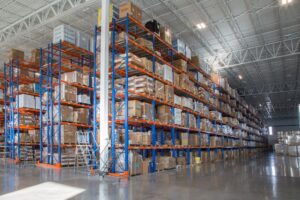
Implementing a warehouse racking system allows businesses to maximize the use of available space, especially by leveraging vertical height. With improved accessibility and vertical storage capacity, companies can double or even triple their inventory volume without expanding their warehouse footprint.
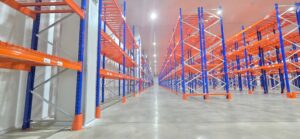
Typically, a racking system includes upright frames, horizontal beams, and shelves or pallets arranged across multiple levels, enabling efficient storage of a wide variety of products within the same space.
Importance of Choosing the Right Warehouse Racking System
Globally, businesses spend up to USD 350 billion each year on warehousing operations, and this figure continues to rise as order sizes become smaller while operating costs steadily increase. This reality puts significant pressure on both profit margins and service quality.
Therefore, choosing the right warehouse racking system has become a strategic decision that enables businesses to optimize storage capacity, control costs, and maintain operational efficiency in an increasingly competitive environment.
A well-selected racking system allows companies to increase storage density without expanding warehouse space. By aligning racking types with product characteristics and inventory turnover rates, businesses can streamline picking routes, reduce travel time, and greatly enhance overall productivity.
While the initial investment may vary depending on the type of system, the long-term operational benefits deliver a substantial return on investment (ROI) through improved efficiency, reduced downtime, and compliance with warehouse safety standards.
⇒ Reference: https://www.mckinsey.com/capabilities/operations/our-insights/improving-warehouse-operations-digitally
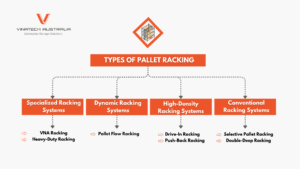
Types of Warehouse Racking Systems
Warehouse shelving systems are designed with many different structures and configurations to suit each type of goods, warehouse layout and operating procedures.
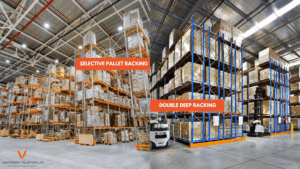
Selective Pallet Racking and Double Deep Racking
Selective Pallet Racking is the most common type of warehouse racking, designed to allow direct access to each pallet. Each storage location is easily accessible, allowing for quick and flexible loading and unloading. This system is ideal for warehouses with a wide range of SKUs and frequent stock rotation.
Double Deep Racking is an extended version of the Selective system, with two rows of pallets stacked on top of each other. This design doubles the storage density, requiring the use of specialized forklifts. The racking is especially effective for warehouses with a moderate range of SKUs and slow inventory turnover.
| Advantages | Disadvantages |
|
|
»» Read more:
https://vinatech.com.au/industrial-warehouse-racking/pallet/
https://vinatech.com.au/industrial-warehouse-racking/pallet/double-deep/
Drive-In and Push Back Racking Explained
- How These Systems Work:
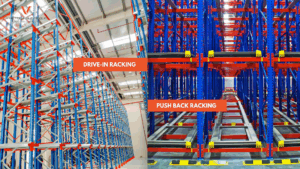
Drive-In Racking is a high-density storage system that allows forklifts to move directly into the lanes to place or retrieve pallets. Goods are stored on a LIFO (Last In, First Out) basis, by eliminating multiple aisles between rack rows, this system maximizes the use of floor space and significantly increases storage capacity.
Push Back racking systems operate on a trolley or tilt rail mechanism, allowing newly stacked pallets to push existing pallets deeper into the lane. When unloading, the front pallets automatically roll forward by gravity, ensuring a smooth picking process. Similar to the Drive-In system, Push Back access is quicker and easier because the forklift does not need to enter the racking structure.
- Suitable Inventory Types
Drive-In Racking is particularly suitable for warehouses that store a limited variety of products in large quantities, such as frozen foods, beverages, or bulk homogeneous goods. In contrast, Push Back Racking is ideal for facilities with medium to high storage volumes, fast-moving inventory, and a strong need to maximize space utilization.
»» Read more:
https://vinatech.com.au/industrial-warehouse-racking/pallet/drive-in/
https://vinatech.com.au/industrial-warehouse-racking/pallet/push-back/
Dynamic Racking Systems (Pallet Flow Racking)
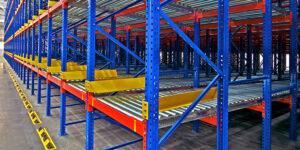
Pallet Flow Racking is an intelligent storage solution that uses roller tracks or inclined rails to move pallets through the system using natural gravity flow. When a pallet is placed at the loading end of the rack, it automatically rolls down to the picking face, and as the first pallet is removed, the next one slides forward to take its place.
This design eliminates the need for multiple aisles, significantly increases storage density, and allows pallets to be stored in deep lanes for maximum space efficiency. Pallet Flow systems are ideal for high-turnover products and time-sensitive goods, such as perishables, beverages, and fast-moving retail items.
Typical applications include:
- Cold storage and food distribution facilities require strict expiry control.
- Businesses with high inventory volumes and fast stock rotation.
- Automated logistics systems that demand high efficiency and minimal manual handling.
»» Read more: https://vinatech.com.au/industrial-warehouse-racking/pallet/pallet-flow/
Other Popular Racking Systems (VNA Racking, Heavy-Duty Racking)
VNA (Very Narrow Aisle) racks are designed with extremely narrow aisles, just wide enough for specialized forklifts to operate, allowing maximum space utilization while still ensuring direct access to each pallet. With a compact design and high precision, this system is especially suitable for warehouses with high storage density but limited floor space.
Heavy Duty Racking is built with a sturdy steel frame, capable of supporting heavy and bulky loads. These systems are often custom designed based on product load and size, ensuring maximum safety, durability and strength in harsh industrial environments.
»» Read more:
https://vinatech.com.au/industrial-warehouse-racking/pallet/very-narrow-aisle/
https://vinatech.com.au/industrial-warehouse-racking/pallet/heavy-duty/
How to Choose the Right Warehouse Racking System
After determining the most suitable warehouse racking system for your business, the next crucial step is to plan and organize its layout strategically.
Factors to Consider
- Inventory
When selecting a warehouse racking system, one of the key considerations is storage density. By analyzing the inventory volume by SKU, businesses can identify areas where deep-lane storage models may be applied effectively.
For warehouses with a wide range of SKUs, varied product sizes, and frequent picking activity, Selective Pallet Racking is the most flexible and efficient choice. Conversely, for homogeneous goods stored in large batches or with slower turnover, deep-lane systems such as Double Deep, Drive-In, or Push Back Racking can help maximize space utilization.
Additionally, companies must take into account the physical characteristics of the products. including size, weight, stability, and any special storage requirements to ensure the chosen racking system meets technical and safety standards.
- Warehouse Dimensions and Layout
Floor space, ceiling height, and aisle space all directly affect rack design. Businesses should first accurately measure available floor space and vertical clearance to determine vertical storage potential.
It is equally important to assess the overall warehouse shape and layout, including the placement of receiving, picking, and dispatch areas. A well-planned layout ensures smooth traffic flow, reduces congestion, and enhances operational efficiency.
- Equipment
The type of forklift or automated equipment used in the warehouse must be fully compatible with the rack structure. Selecting racks that do not match the existing equipment can reduce productivity. Therefore, it is important to evaluate the load capacity and handling specifications of all equipment to ensure full compatibility.
Furthermore, designing and aligning rack layouts with actual workflow models helps optimize the handling and movement of inventory, thereby improving overall warehouse efficiency and safety.
Routine Maintenance and Safety Checks
Compliance with safety standards and legal regulations is mandatory for all warehouse racking systems to protect people, goods and facilities from potential risks during operation. The system must be continuously maintained through periodic inspections and scheduled maintenance.
Regular maintenance plays an important role in prolonging the life of the racking system, while ensuring the system operates safely, reliably and in compliance with technical standards. Regular inspections are not only a technical requirement but also a long-term commitment to safety and operational responsibility.
Can Warehouse Racking Be Customized?
Customizing a warehouse racking system is key to creating an efficient and well-structured warehouse layout. When racking configurations are tailored to the specific space and operational processes of a business, they can deliver maximum storage efficiency and performance.
The benefits of customization include improved storage density, better inventory control, and greater adaptability to changing business requirements. Furthermore, customized racking systems enhance workplace safety, helping to minimize handling errors and reduce the risk of accidents.
Future of Warehouse Racking System – Moving Toward Automation and Smart Warehousing
The warehouse automation market is expanding rapidly. Experts predict that the number of automated transport robots will grow by up to 50% annually through 2030, while warehouse automation itself is expected to achieve a growth rate of over 10% per year.
Key Technologies Driving the Future of Warehousing
In the near future, storage systems will evolve beyond static racks to become fully connected ecosystems that seamlessly integrate hardware and digital technology. The convergence of autonomous robots (AGVs, AMRs), IoT sensors, and big data analytics will allow businesses to monitor, manage, and optimize their entire warehouse operations in real time.
Advanced solutions such as Shuttle Systems and ASRS (Automated Storage and Retrieval Systems) are emerging as industry standards, allowing companies to increase storage density, reduce manual labor, and enhance the speed and accuracy of inventory handling.
Businesses must proactively prepare their technical infrastructure, plan warehouse layouts strategically, and invest progressively in automation technologies. Transitioning to a smart warehouse helps cut costs, reduce risks, and boost competitiveness in today’s fast-evolving market.
Reference: https://www.mckinsey.com/capabilities/operations/our-insights/getting-warehouse-automation-right
Why choose Vinatech Australia?
Vinatech Australia is proud to deliver innovative racking and smart storage solutions, offering the perfect combination of advanced technology, optimized design, and professional service.
With years of industry experience and a team of highly skilled engineers, Vinatech goes beyond simply providing products, we partner with businesses to build modern, efficient, and safe warehouse environments.
Vinatech Australia – Smart Warehouse Solutions
🌐 Website: https://vinatech.com.au/
☎️ Phone number: 0406 916 355
📩 Email: info@vinatech.com.au
📌 Address: 48/58 Cyber Loop, Dandenong South VIC 3175, Australia

My name is William Harris, and I am the Production Director at Vinatech Australia. I oversee the entire manufacturing operation for our industrial warehouse racking systems and the development of smart warehouse solutions.