
Pallet Racking Systems: 6 Types, Components & Applications in Australia
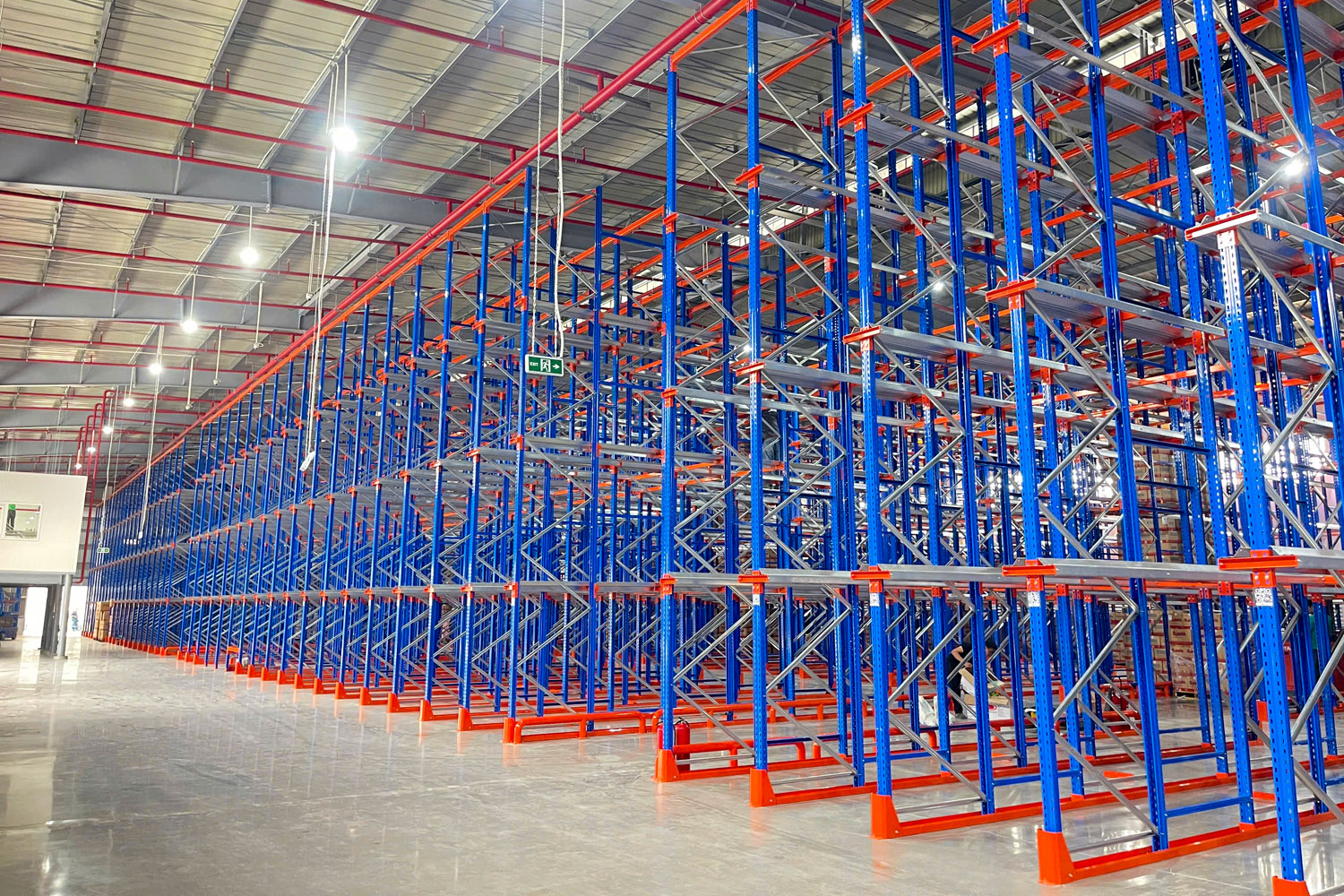
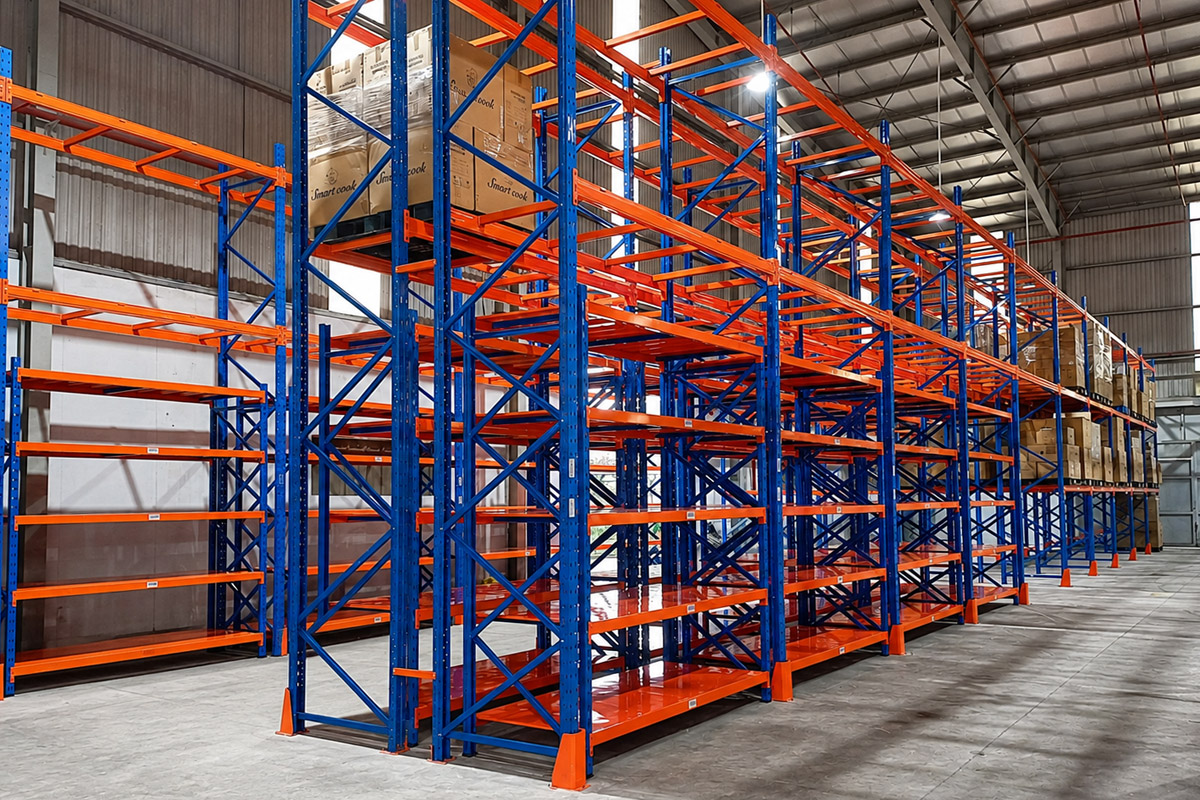
Pallet racking stores palletised goods across multiple levels, helping warehouses make better use of vertical space. It supports organised storage and efficient forklift access, with configurations suited to different inventory volumes and handling requirements.
For Australian warehouses, six options to consider are Selective, Drive-In, Double-Deep, Pallet Flow, Push-Back and Pallet Shuttle Systems. Choosing the right system depends on storage density, pallet accessibility, stock rotation and handling equipment.

Planning Your Next Warehouse Project?
Let’s Make It Work Better Chat on WhatsApp
6 Types of Pallet Racking for Australian Warehouses
Six pallet racking options to consider for Australian warehouses are selective, drive-in, double-deep, pallet flow, push-back and pallet shuttle systems. Each offers a different balance between storage density, pallet accessibility, stock rotation and handling requirements.
1. Selective Pallet Racking
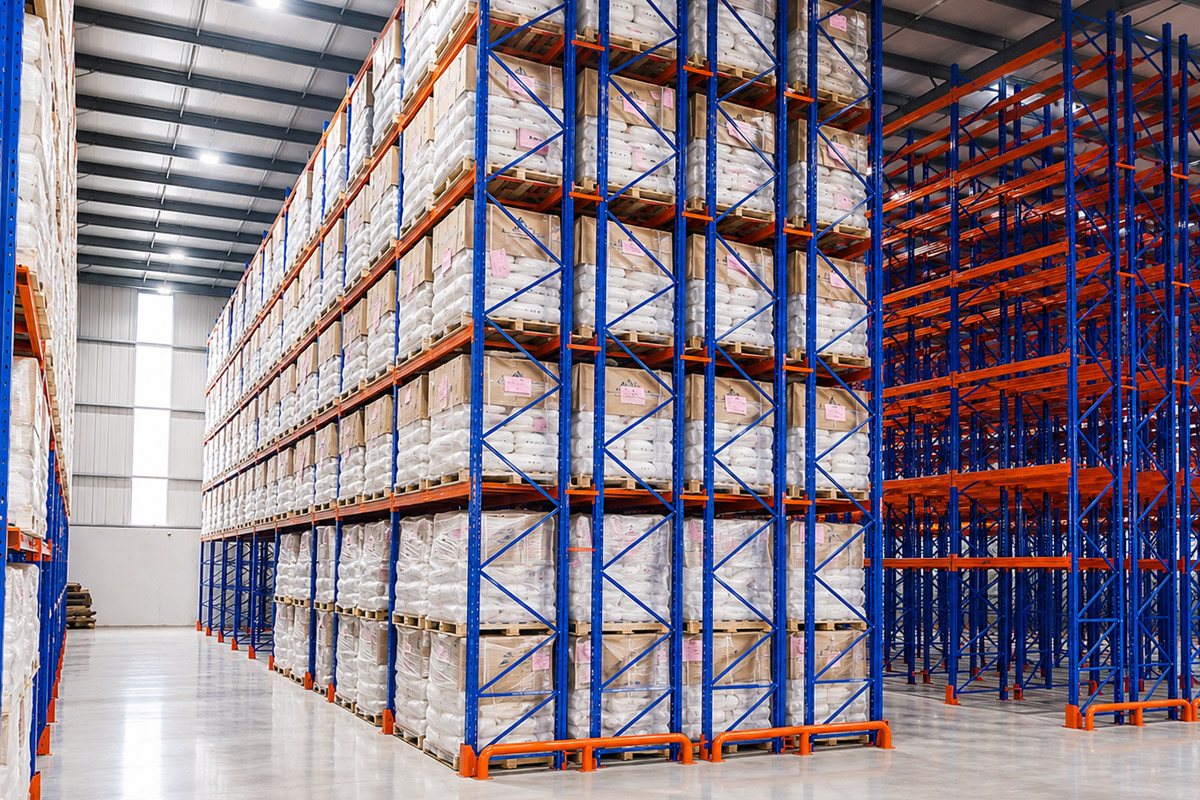
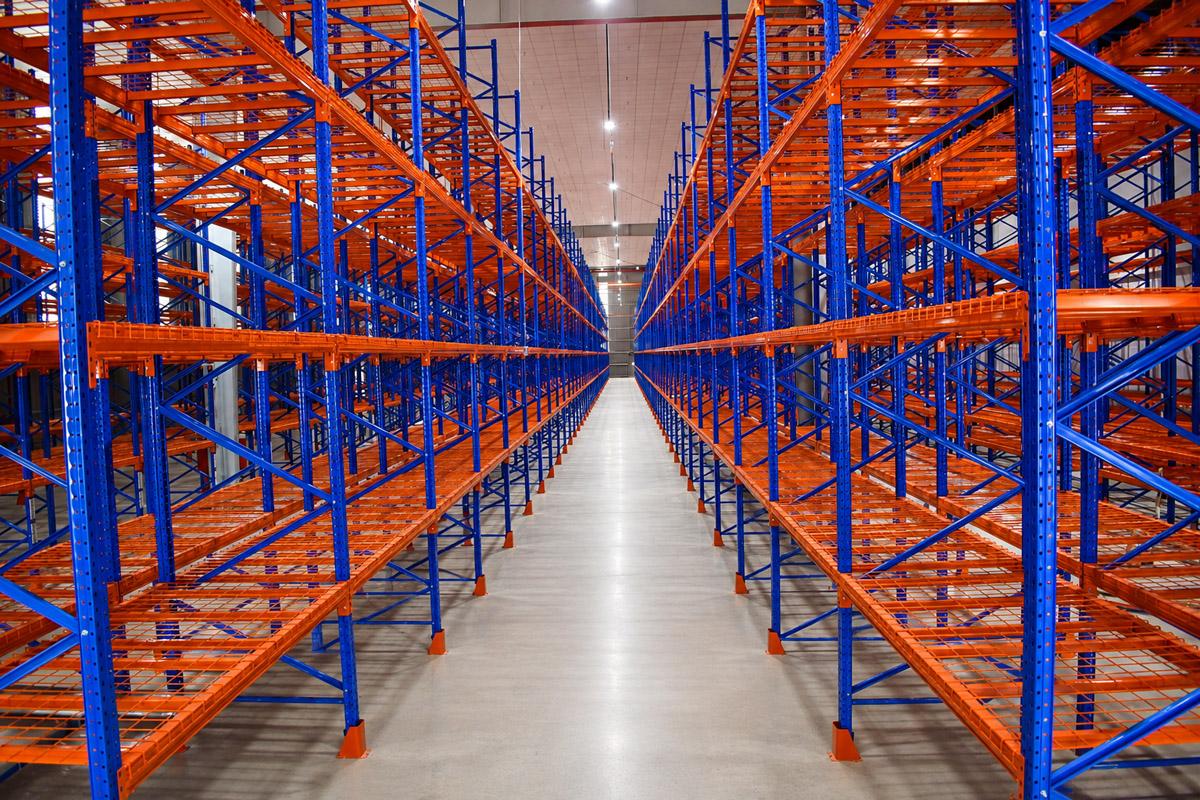
Selective pallet racking provides direct access to every pallet, making it well suited to warehouses with a wide range of SKUs. Teams can pick, replenish and count stock without moving other pallets first.
Each pallet occupies a separate storage position accessible from the aisle. Depending on the layout, a standard counterbalance forklift or reach truck can handle loading and retrieval. The trade-off is lower storage density, as more floor space is needed for aisles.
- Access: Direct access to every pallet
- Density: Lower than high-density systems such as drive-in or shuttle racking
- Best for: High-SKU warehouses, third-party logistics (3PL) facilities and operations requiring frequent access to individual pallets
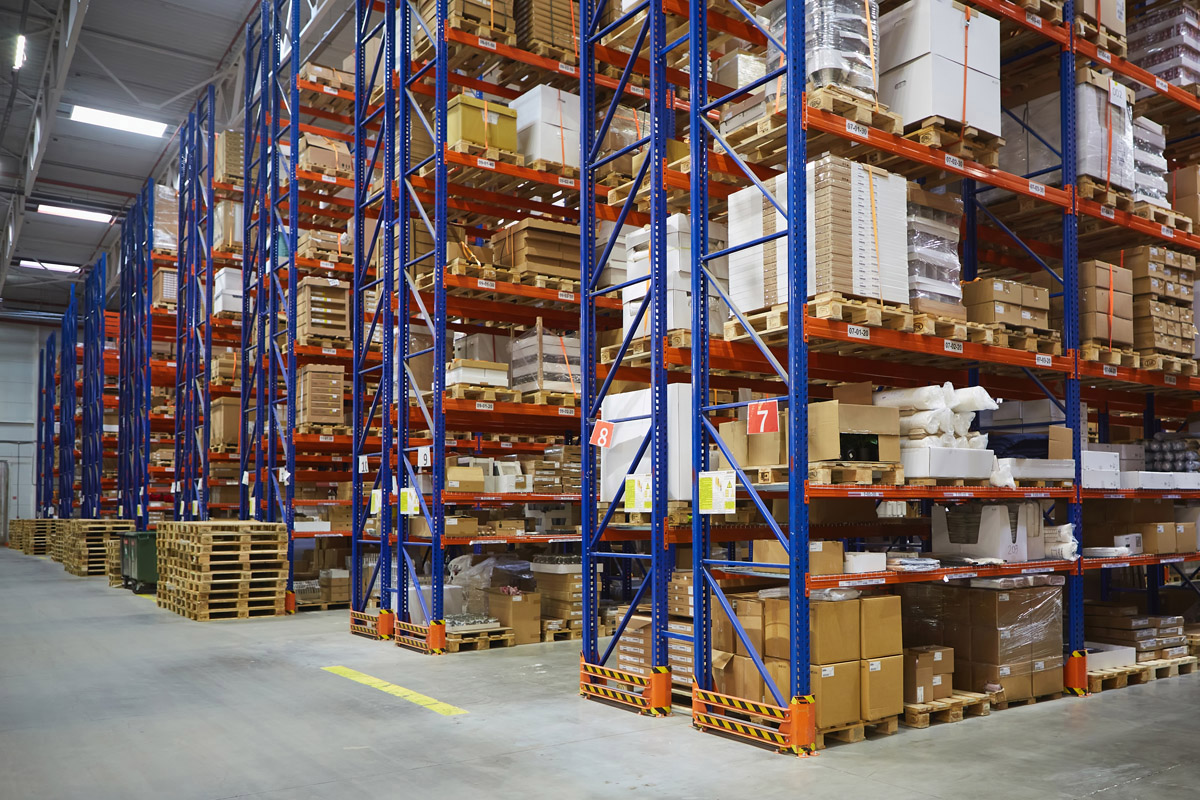
2. Drive-In and Drive-Through Racking
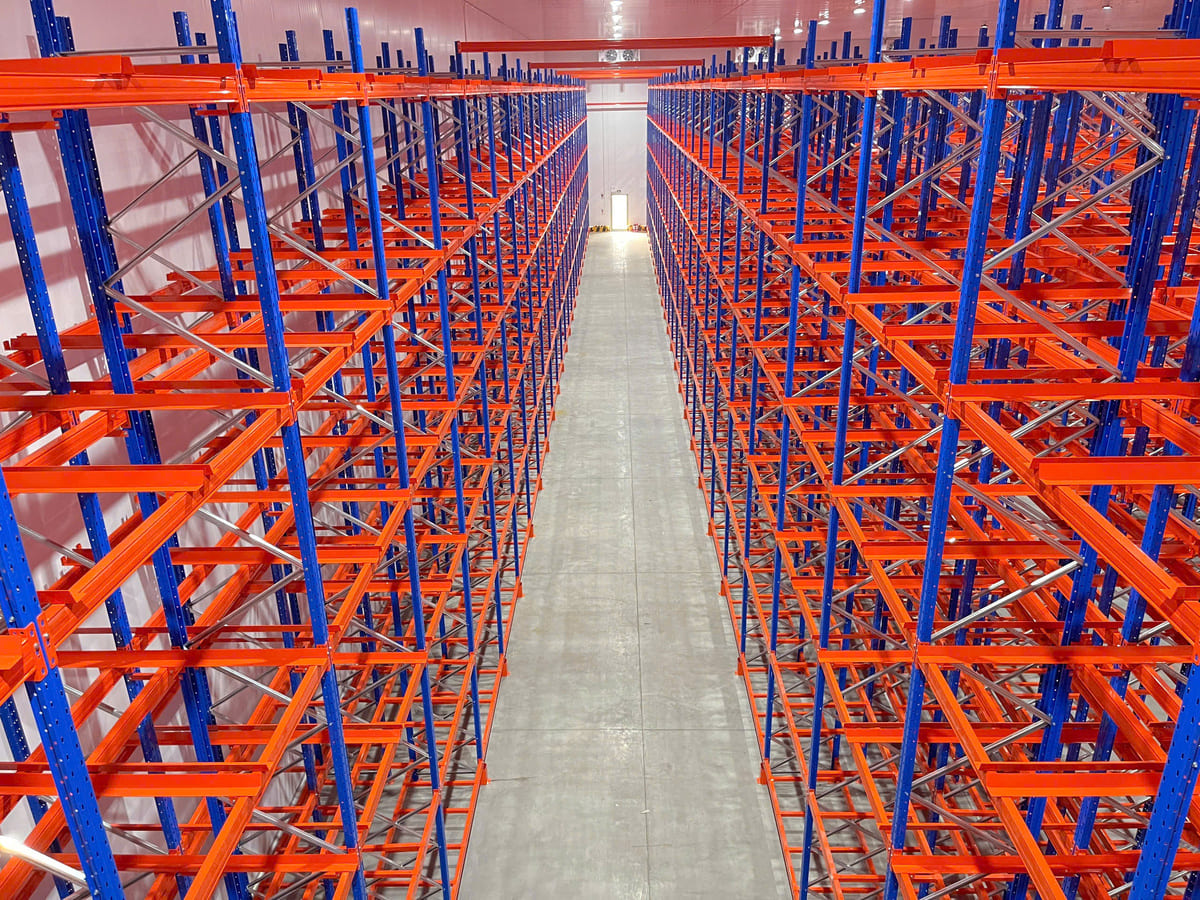
Drive-in and drive-through racking increase storage density by reducing aisle space. Forklifts enter the storage lanes to load or retrieve pallets, allowing multiple pallets to be stored in depth.
The two configurations differ in how stock moves through the system. Drive-in racking uses the same entry point for loading and retrieval, following a Last-In, First-Out (LIFO) sequence. Drive-through racking provides access at opposite ends and can support First-In, First-Out (FIFO) rotation.
This arrangement suits large quantities of a limited number of SKUs, although access to individual pallets is restricted by their position within the lane.
- Access: Restricted; LIFO for drive-in, with FIFO possible in drive-through layouts
- Density: Very high
- Best for: Bulk storage with low SKU counts, including beverages, building materials and cold-storage operations
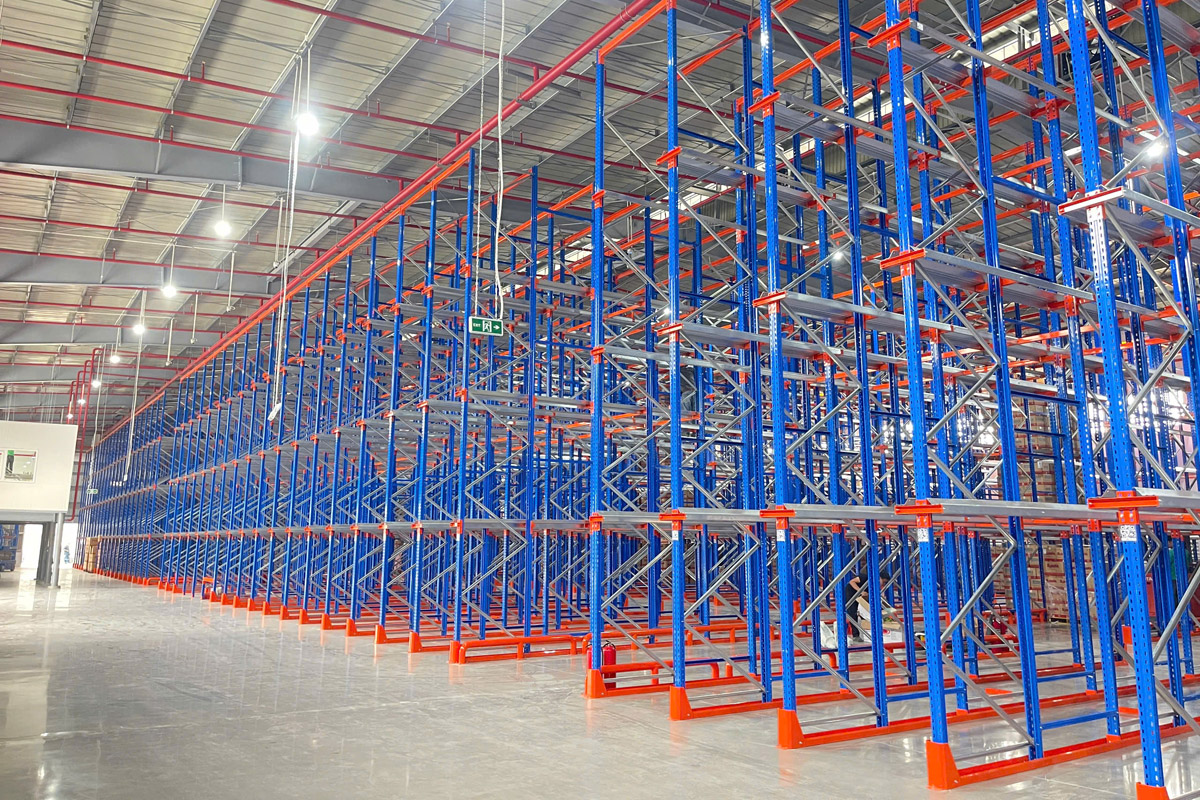
3. Double Deep Racking
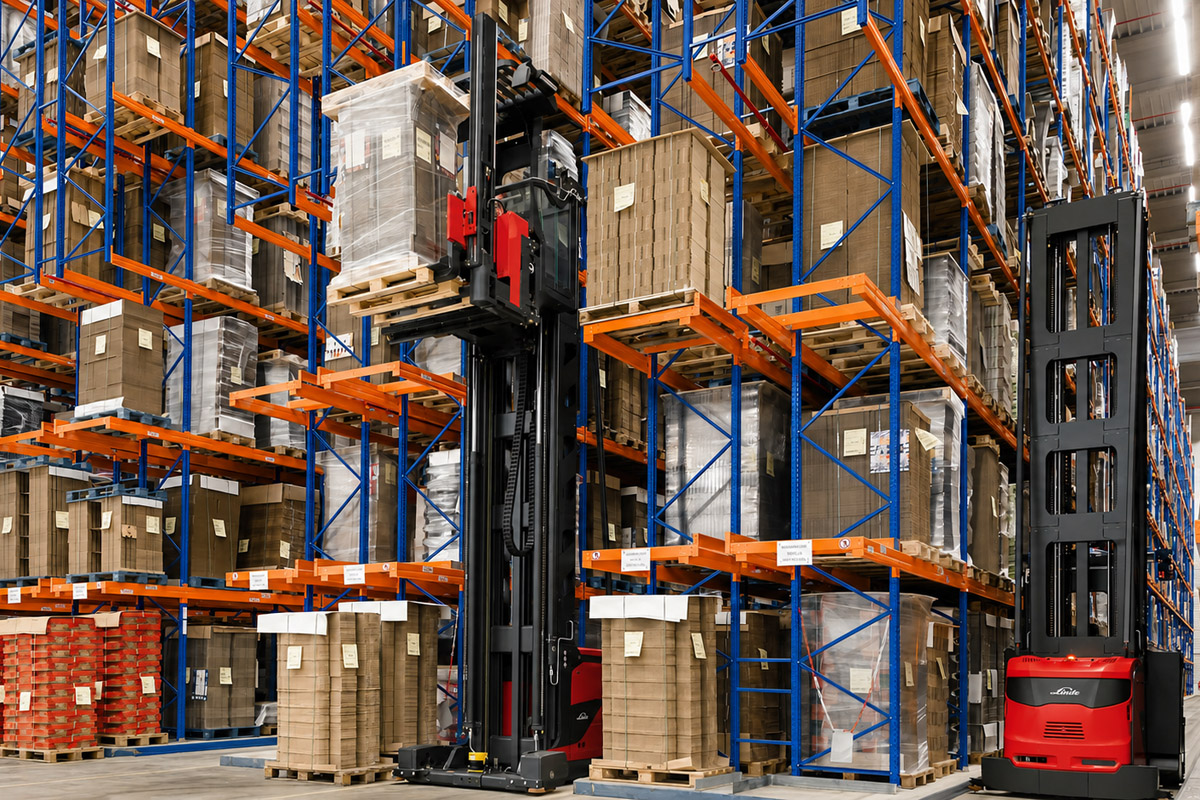
Double-deep racking stores pallets two positions deep on each side of an aisle. By reducing the number of aisles needed, it offers greater storage density than selective racking.
Access involves a compromise: the front pallet must be removed before the rear pallet can be retrieved. This makes the system better suited to operations holding multiple pallets of the same SKU than those needing immediate access to every pallet.
A reach truck equipped for double-deep handling is typically required to load and retrieve pallets in the rear position.
- Access: Direct access to front pallets; rear pallets require front-pallet removal
- Density: Higher than selective racking; layout-dependent
- Best for: Warehouses with moderate SKU counts and multiple pallets per SKU
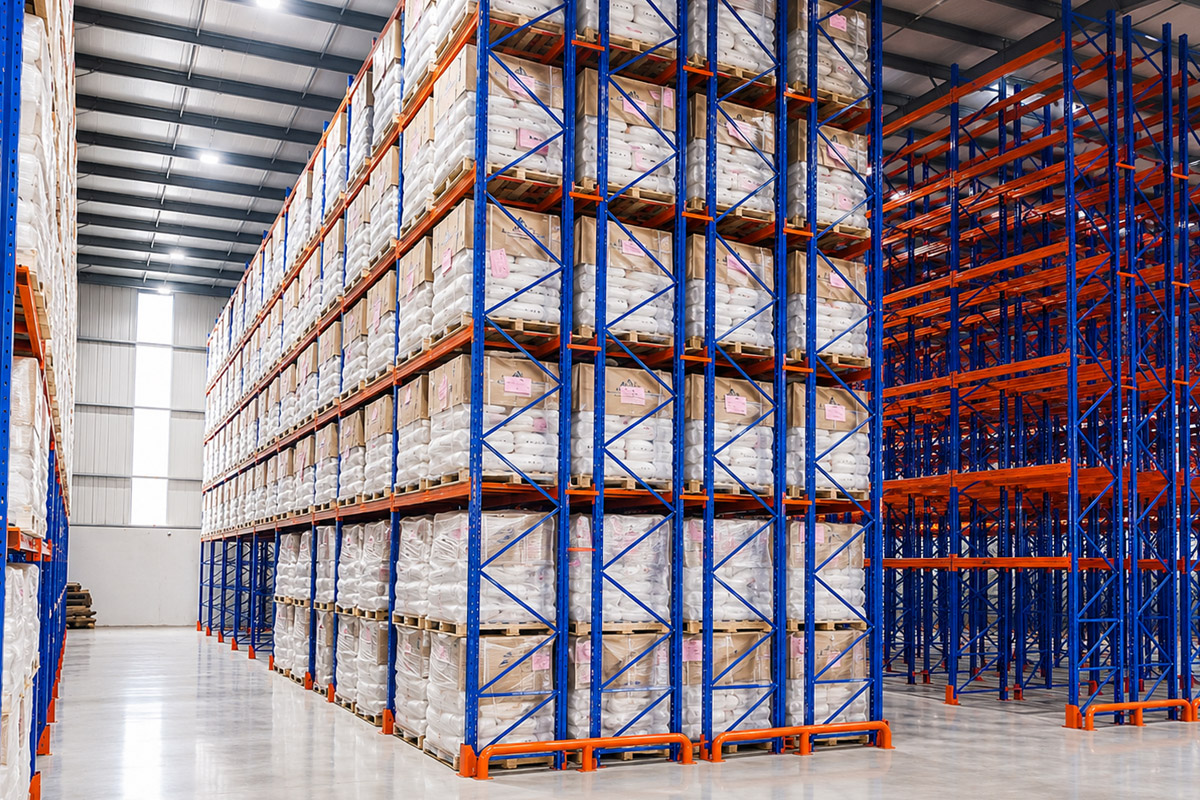
4. Pallet Flow Racking
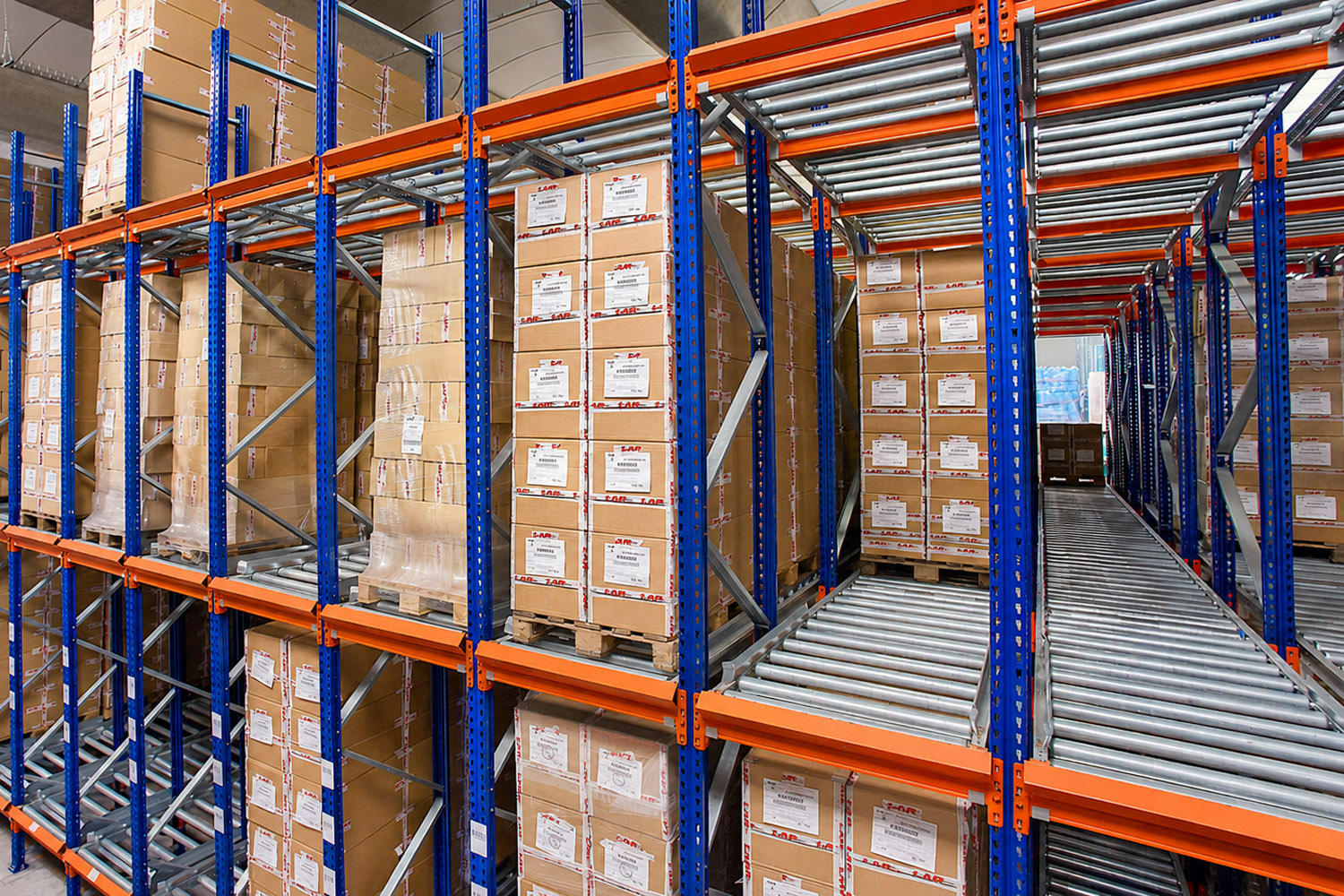
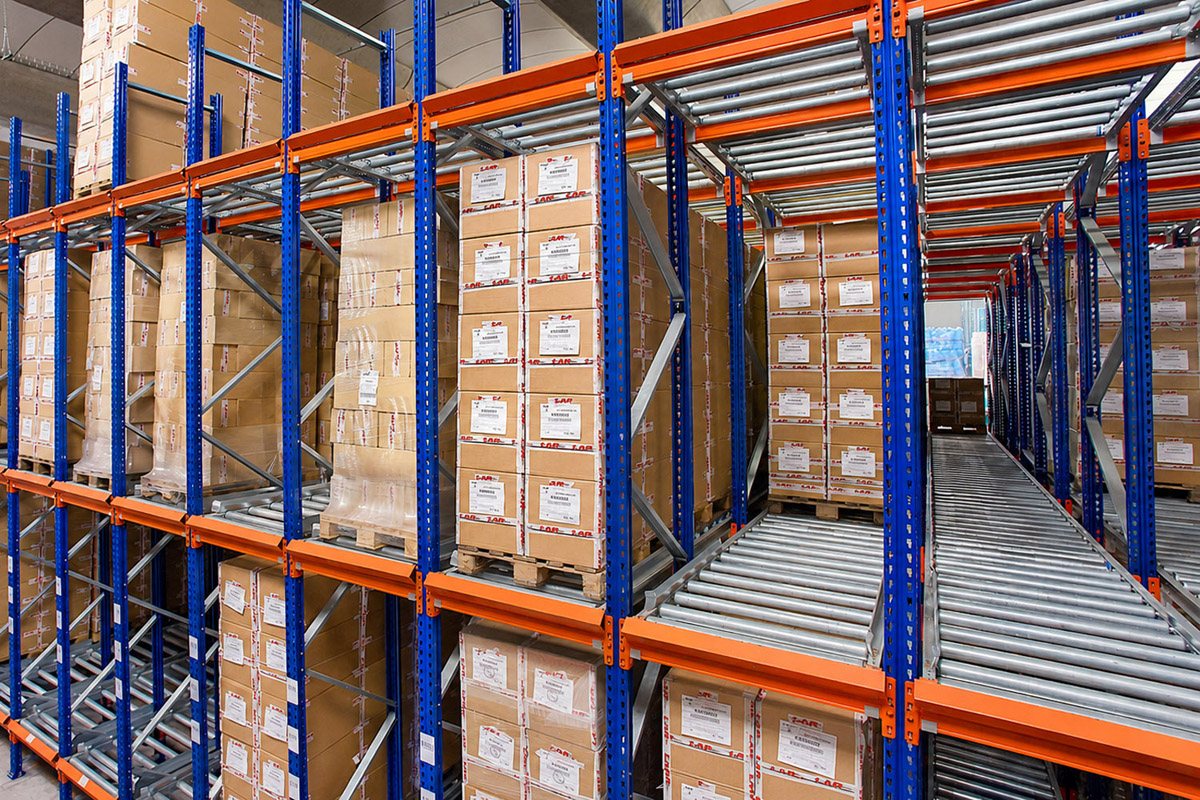
Pallet flow racking combines high-density storage with FIFO stock rotation. Pallets travel along slightly inclined roller or wheel tracks from the loading side towards the picking face.
When the front pallet is removed, gravity moves the next pallet forward. Loading and retrieval take place at opposite ends, reducing the need to reposition stock within each lane.
- Access: Sequential access following FIFO
- Density: High
- Best for: Food, beverage, cold-storage and pharmaceutical operations that require FIFO stock rotation
5. Push-Back Racking
Push-back racking stores multiple pallets deep while keeping forklifts outside the rack structure. During loading, each new pallet pushes the existing pallets further into the lane on nested carts or carriers.
Removing the front pallet allows those behind it to move forward under gravity. Loading and retrieval use the same aisle, so stock follows a LIFO sequence.
- Access: From the front of each lane, following LIFO
- Density: High; lane depth depends on the configuration
- Best for: Grocery, beverage and consumer-goods warehouses holding multiple pallets per SKU where LIFO is suitable.
6. Shuttle Racking System
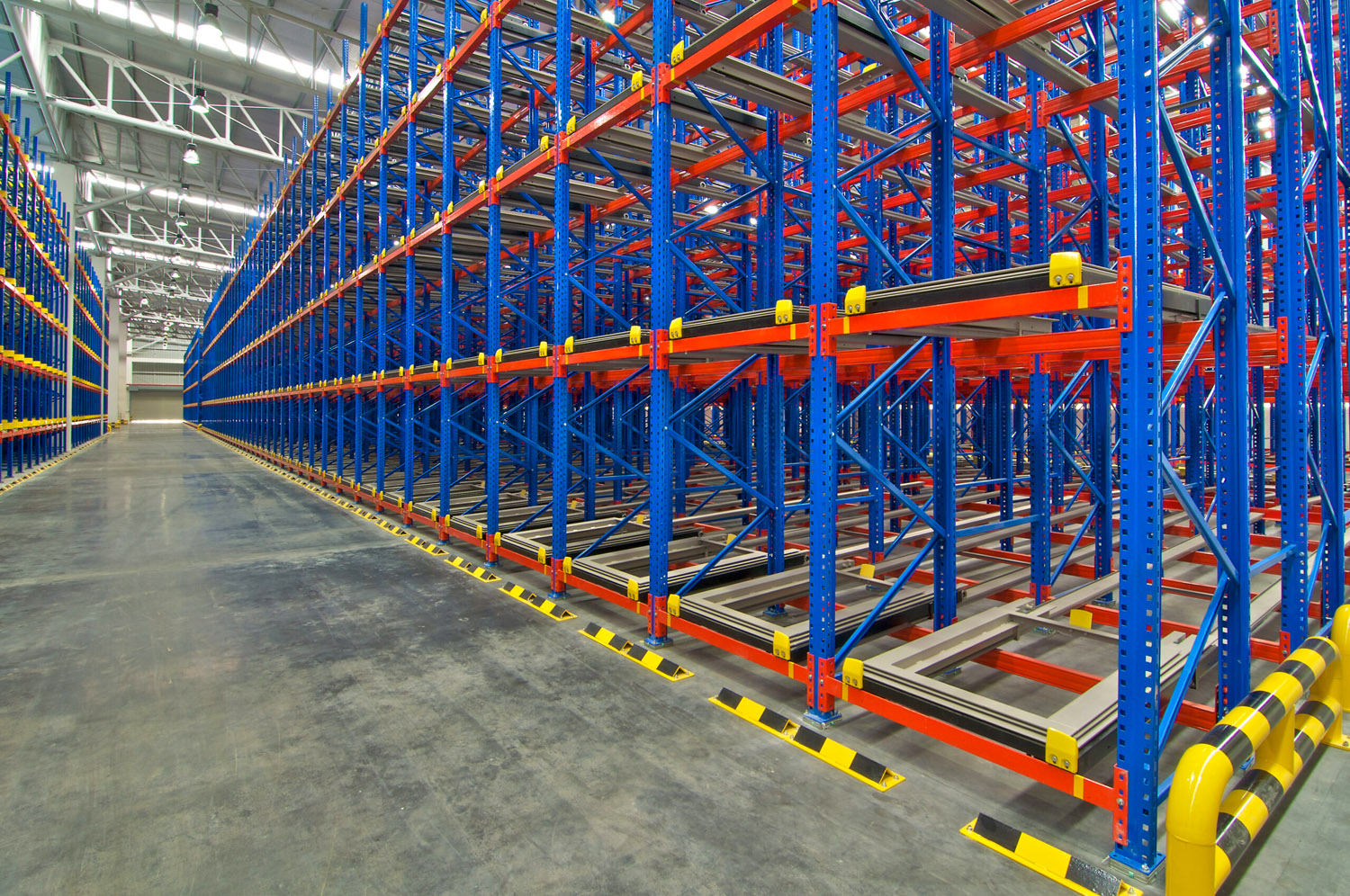
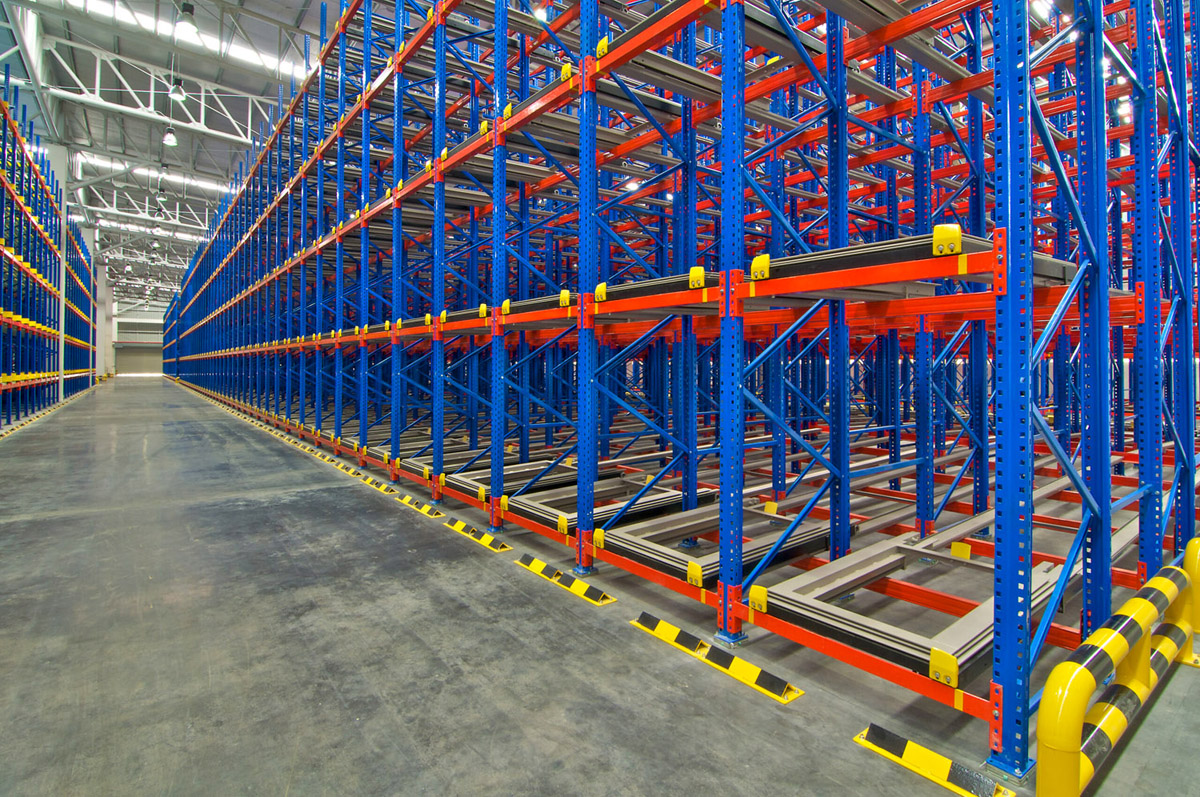
Pallet shuttle racking uses a powered shuttle to transport pallets along storage lanes. In a semi-automated installation, a forklift places pallets at the lane entrance, and the shuttle moves them into position. For retrieval, it brings pallets back to the collection point.
Forklifts remain outside the lanes and relocate the shuttle between channels as required. The layout can support LIFO with access from one side or FIFO with loading and retrieval at opposite ends.
- Access: Shuttle-assisted retrieval at the lane entrance
- Density: Very high
- Best for: High-volume distribution centres and cold stores handling large quantities of each SKU
CONSULTATION ON PALLET RACKING SYSTEMS FOR YOUR WAREHOUSE
Call: 0485 083 868 Get In Touch
Comparison of Pallet Racking Systems
Use the table below to compare access, stock rotation and equipment requirements. Storage density is indicative: the final capacity depends on lane depth, aisle widths, rack height and pallet dimensions.
| Racking System | Best For | Storage Density | Pallet Access | Stock Rotation | Handling Equipment |
|---|---|---|---|---|---|
| Selective Pallet Racking | High SKU warehouses, fast picking, retail, 3PL | Lower than high-density systems | Direct access to every pallet | Flexible; FIFO or LIFO managed through picking procedures | Counterbalance, Reach Truck |
| Double Deep Racking | Medium SKU count, higher pallet capacity, bulk storage | Higher than selective racking | Direct access to front pallets; rear pallets require front-pallet removal.ssed via front | LIFO | Reach truck equipped for double-deep handling |
| Drive-Through Racking | Bulk storage with low SKU counts requiring FIFO rotation | High; layout-dependent | Lane-based access from opposite ends | FIFO | Compatible forklift sized for the rack lanes |
| Push-Back Racking | Medium SKU count, high-density storage, fast-moving inventory | High | Front pallet access; pallets move forward automatically | LIFO | Counterbalance, Reach Truck |
| Pallet Flow Racking | FIFO inventory, food, beverage, pharmaceuticals, high-throughput warehouses | High | Loading and picking from opposite sides | FIFO | Counterbalance, Reach Truck |
| Shuttle Racking System | High-volume warehouses, cold stores and semi-automated high-density storage | Very High | Shuttle retrieves pallets; forklift remains outside lanes | FIFO or LIFO | Compatible forklift and pallet shuttle |
Pallet Racking Structure and Components
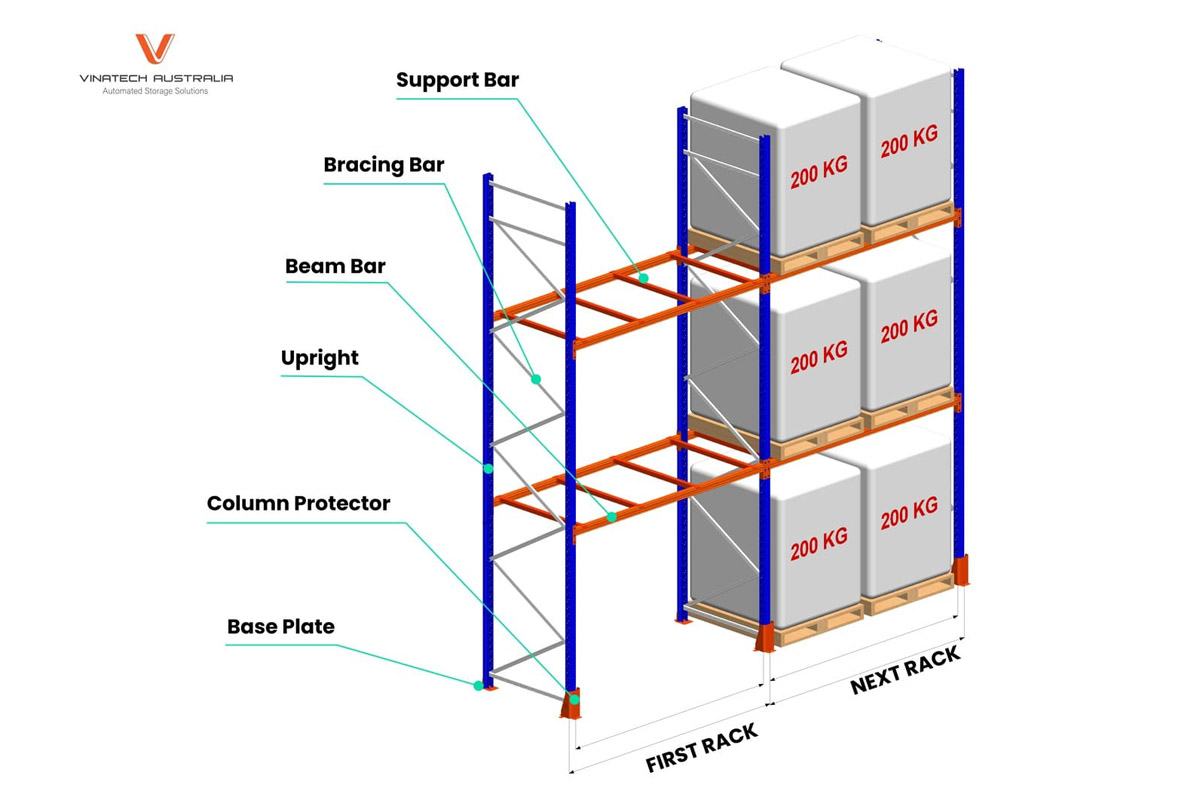
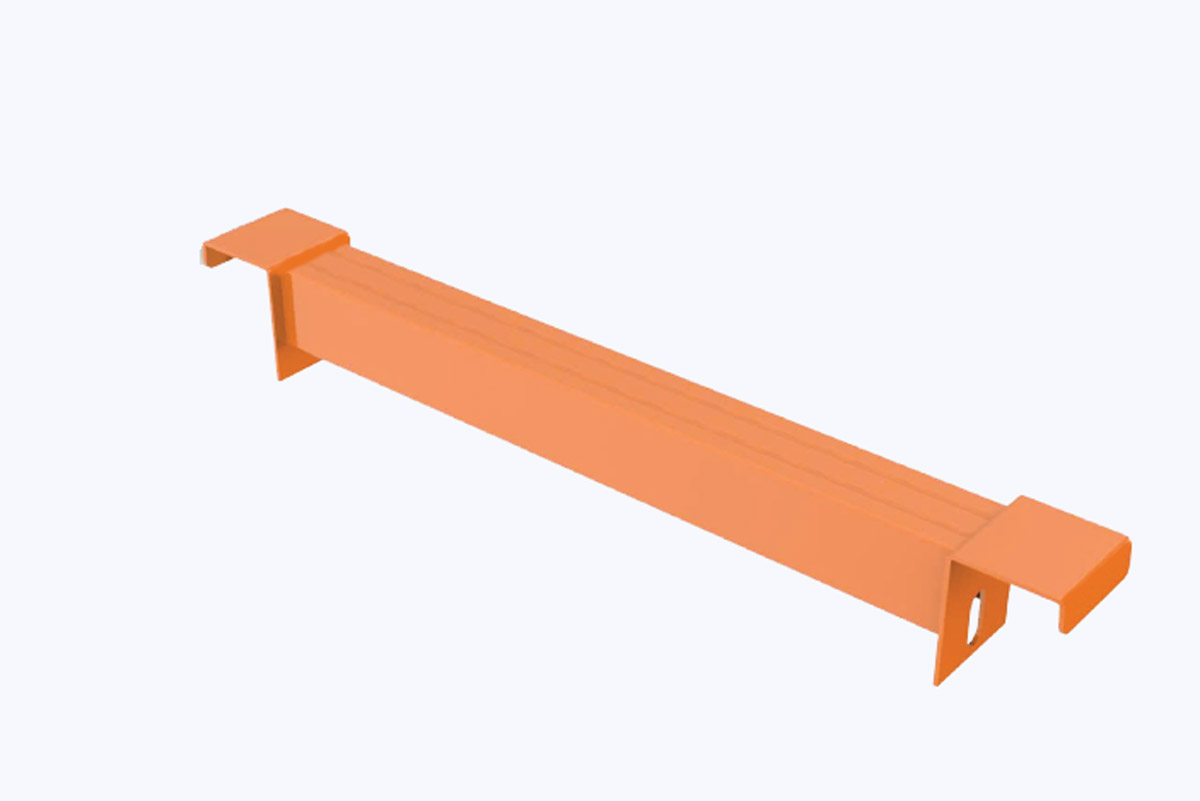
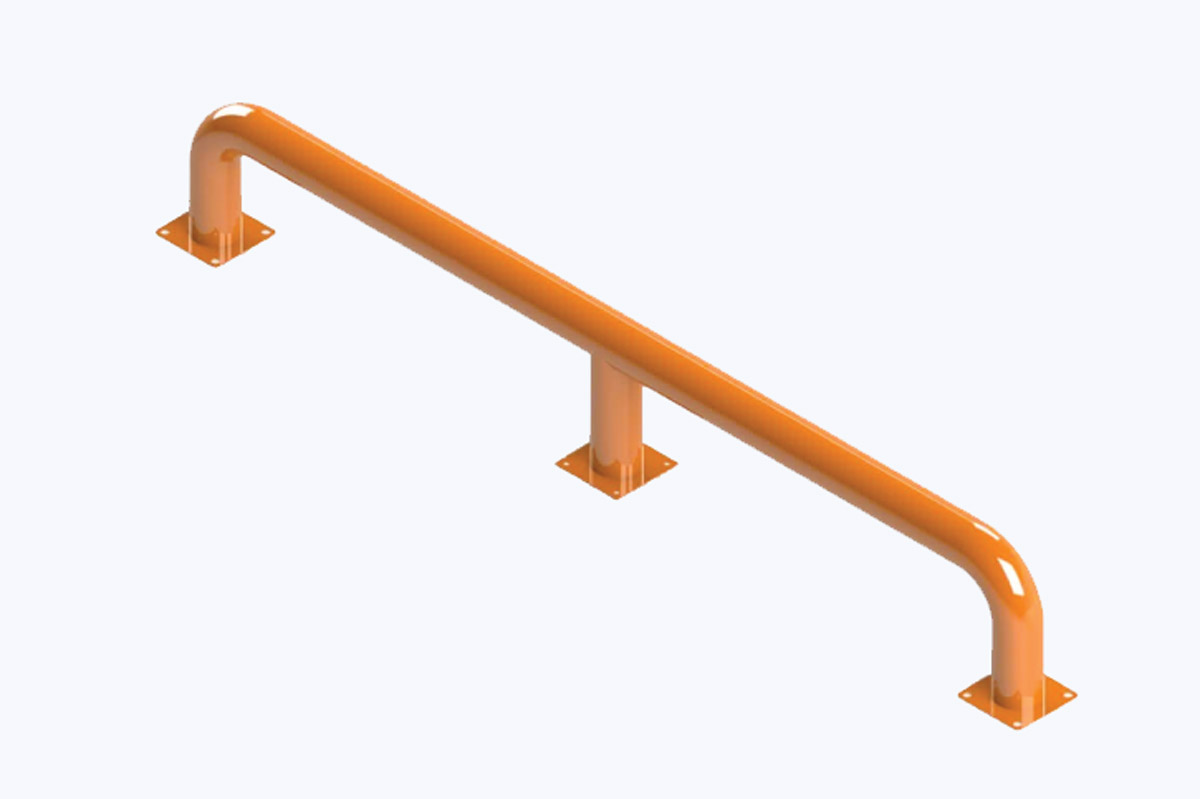
The rack structure carries the stored loads, while accessories support specific pallet types and help protect exposed areas. Component selection depends on the racking system, load requirements and warehouse layout.
Primary Structural Components
- Upright frames: Vertical assemblies that carry rack loads and transfer them to the floor.
- Load beams: Horizontal members that connect the frames and support pallets or decking.
- Frame bracing: Horizontal and diagonal members that stabilise the upright frames.
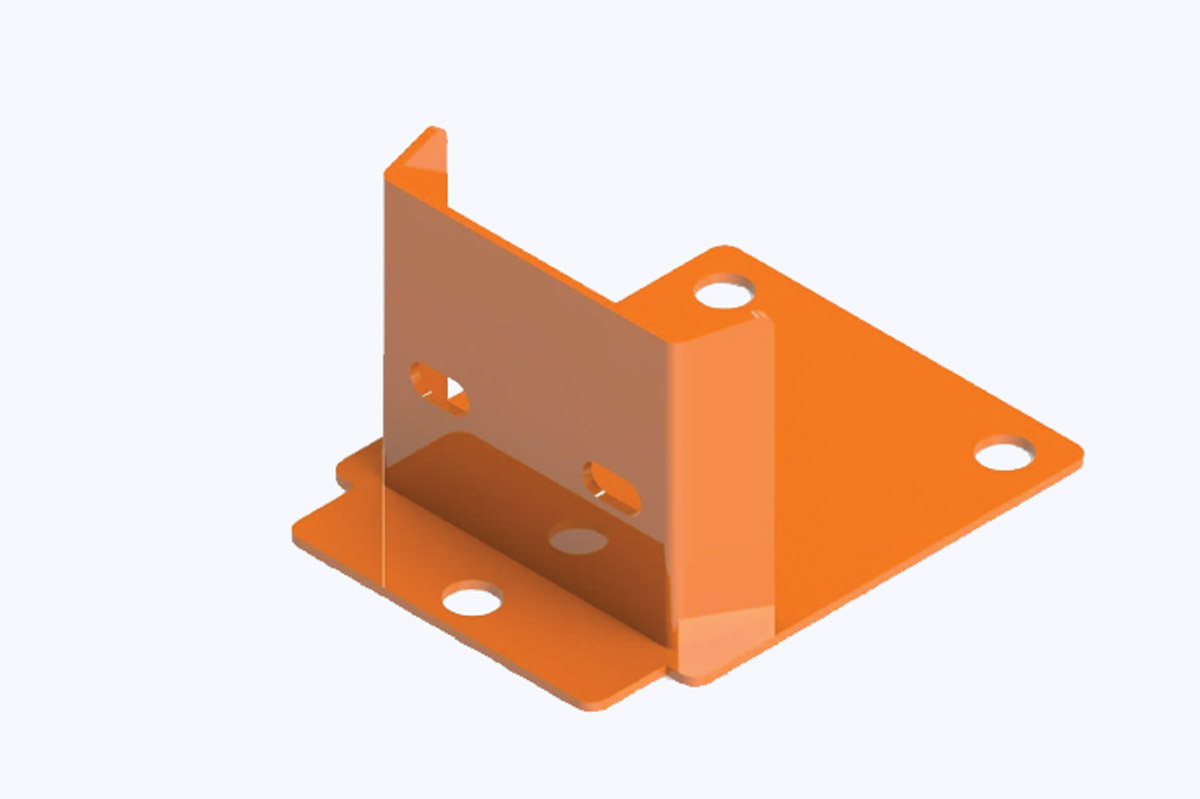
- Base plates and anchors: Components that transfer loads at the upright bases and secure the installation to the floor.
Supporting Accessories
Accessories should match the rack design and their intended function.
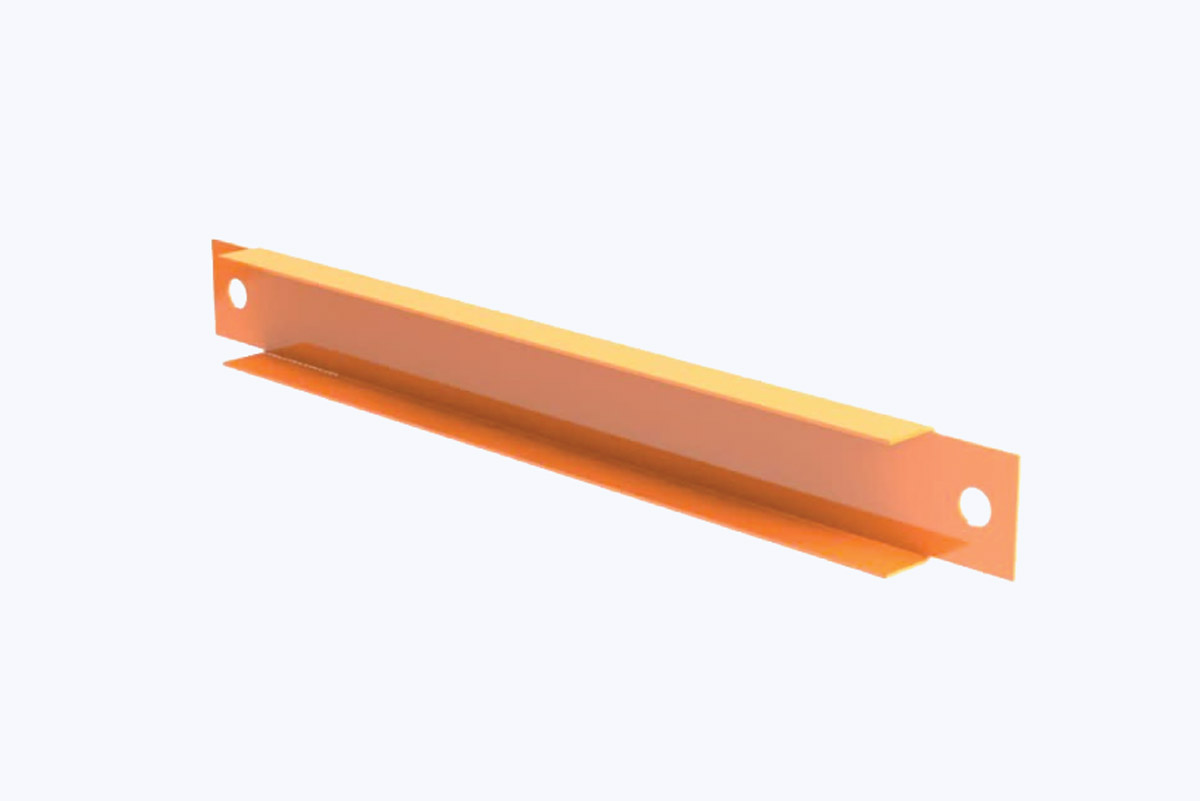
- Pallet support bars: Members fitted between beams to provide additional support for compatible pallets or decking.
- Decking: Panels or mesh that form a supporting surface where required by the storage design.
- Row spacers or connecting bars: Components that maintain the specified spacing between connected rack rows.
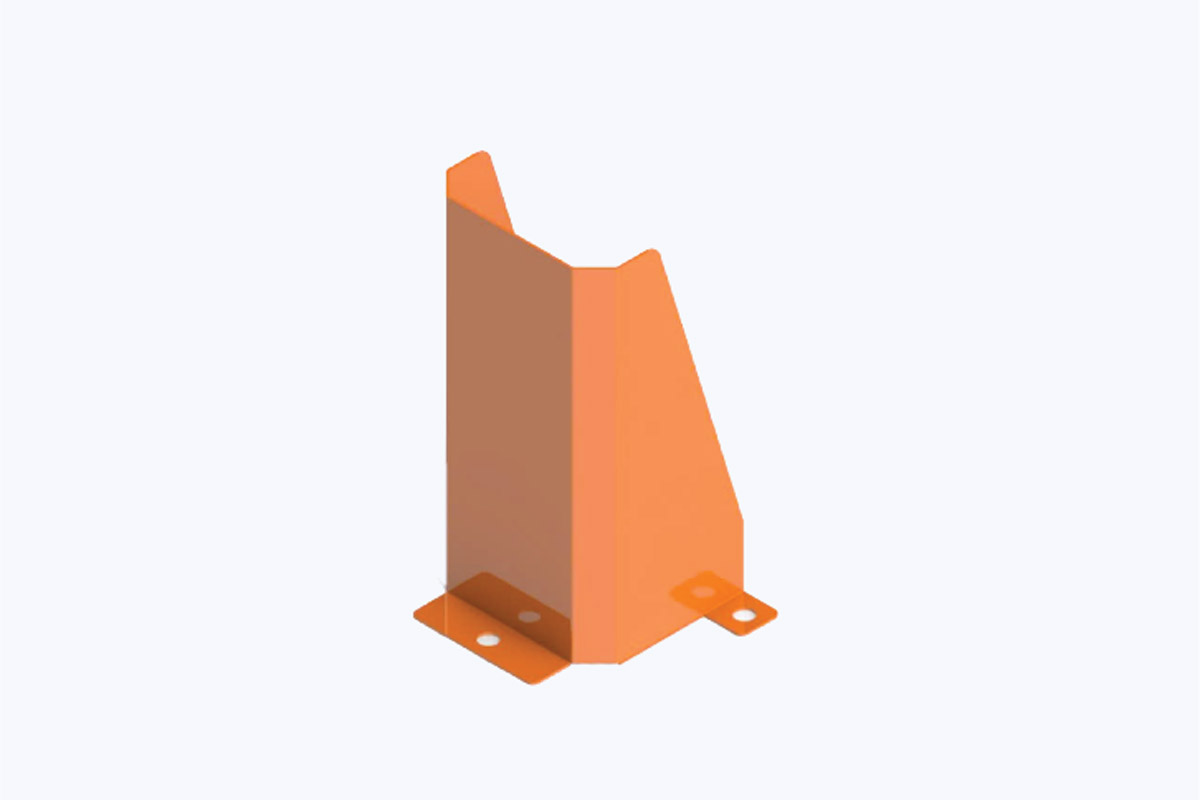
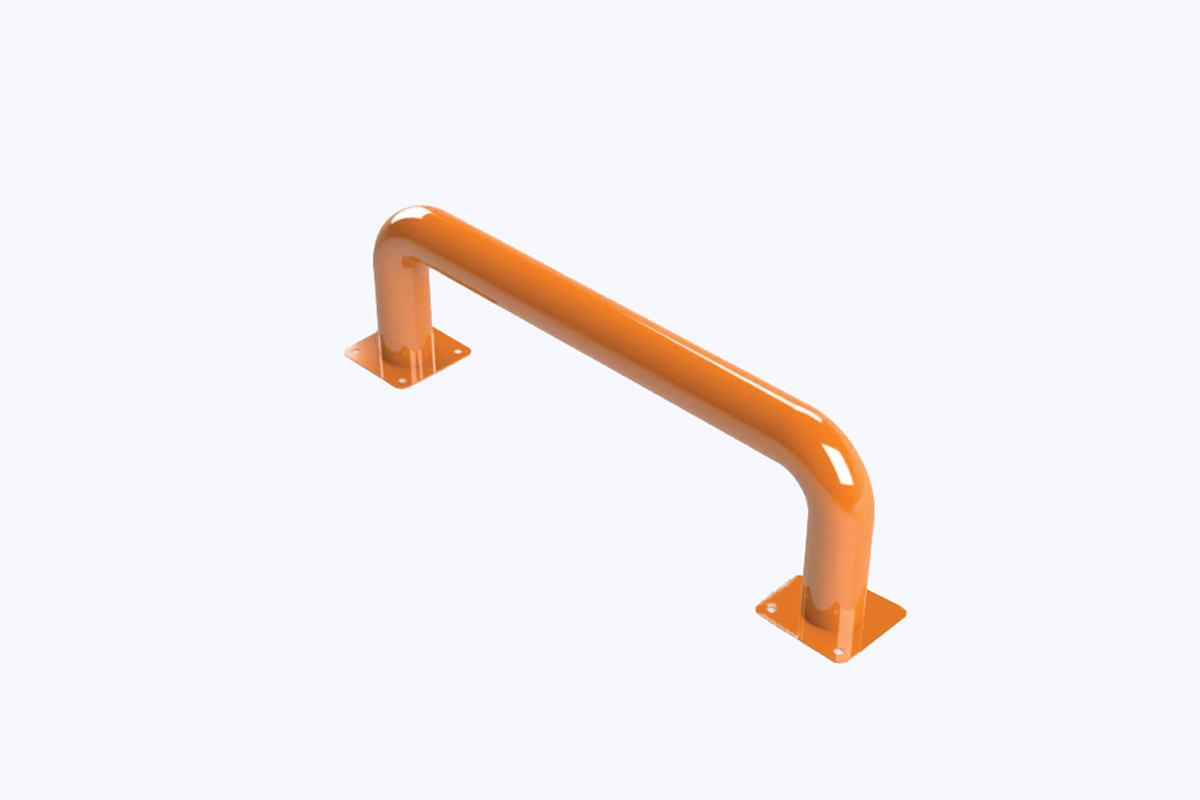
- Upright protectors: Guards positioned around exposed upright bases to help reduce impact damage.
- Rack-end barriers: Floor-mounted protection for vulnerable areas at the ends of rack rows.
- Base plate covers: Covers fitted over the foot area where specified; these do not replace structural impact protection.
Read more: Industrial Warehouse Racking | 7 Types for Australian Warehouses
Pallet Racking Applications by Industry
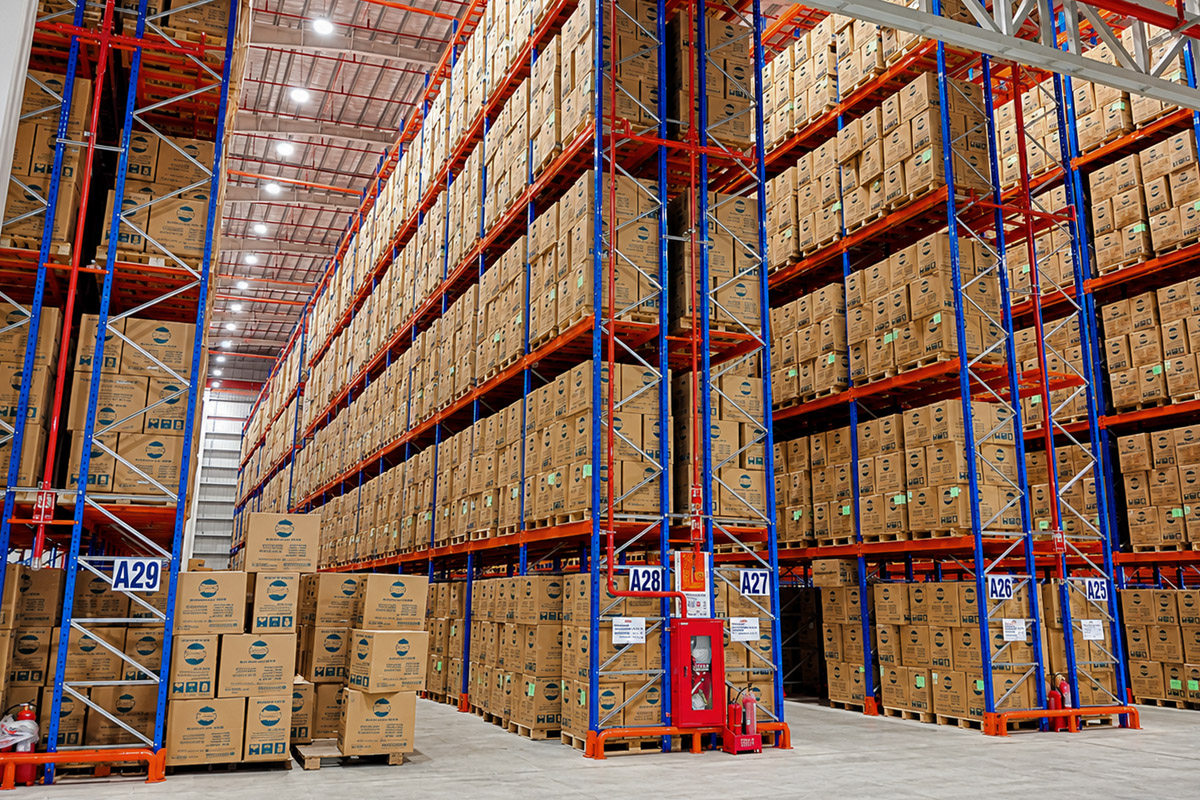
Pallet racking supports storage and material handling across industries by matching warehouse layouts to inventory, load and stock movement requirements. Its applications range from providing direct access to diverse product lines to storing large volumes of similar goods.
- Logistics, 3PL and distribution: Pallet racking accommodates varied inventories and supports frequent inbound and outbound pallet movements.
- Retail and e-commerce: It organises palletised reserve stock for replenishing order-picking areas.
- Food, beverage and pharmaceuticals: Suitable configurations support stock rotation and batch control while accounting for product shelf life and temperature requirements.
- Manufacturing and automotive: Pallet racking keeps raw materials, components, work-in-progress and finished goods organised to support production.
- FMCG and consumer goods: It supports frequent replenishment and high pallet turnover.
- Building materials and heavy industry: Systems designed for the required load weights and dimensions accommodate heavy or bulky palletised goods.
Discover how different industries use pallet racking to optimise warehouse storage.
Pallet Racking Dimensions & Specifications in Australia
Rack dimensions and load ratings must suit the goods being stored and the equipment used to handle them. A supplier’s catalogue provides a starting point, but the final specification depends on the installation.
Rack Dimensions and Load Capacity
Key specifications include beam length, frame height and depth, upright and beam profiles, and the spacing between storage levels.
Load limits must cover individual unit loads, beam levels and complete bays. Use the ratings supplied for the installed configuration rather than applying a general capacity range to every rack.
Australian Standards and Inspections
AS 4084.1:2023 covers steel storage racking design, while AS 4084.2:2023 addresses operation and maintenance.
SafeWork NSW advises regular checks and formal inspections by a competent person at intervals no greater than 12 months. Racking must remain within its rated capacities, with damage reported promptly for assessment.
Pallet Compatibility
Confirm pallet dimensions, construction, condition and loaded weight before selecting a racking system. Pallet height, self-weight and load capacity vary by design, so these should be checked against the pallet supplier’s specifications.
Forklift Aisles and Clearances
Aisle widths should suit the forklift’s operating requirements, the load dimensions and the rack layout. Warehouse planning must also account for pedestrian movement and emergency access. SafeWork NSW specifically advises matching aisle width to the handling equipment used.
Featured Pallet Racking Case Studies by Vinatech
Explore how Vinatech’s pallet racking solutions optimise warehouse storage capacity, improve pallet accessibility and enhance operational efficiency across FMCG and logistics industries.
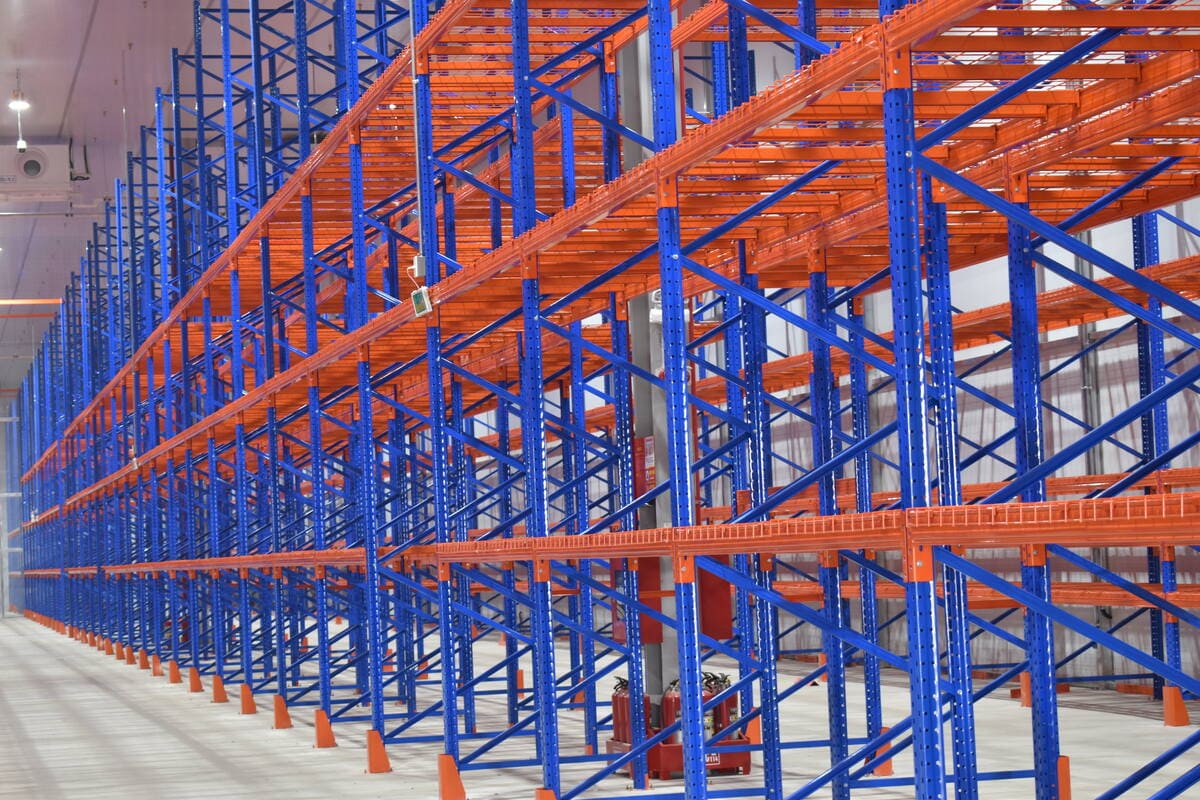
1. FMCG & Consumer Goods Distribution – Selective Pallet Racking
Vinatech implemented a Selective Pallet Racking System providing approximately 16,800 pallet positions within a 20,000 m² warehouse, utilising a 15-metre warehouse height to maximise vertical storage capacity.
The project achieved approximately 65% higher storage capacity, 30% greater pallet handling throughput and an estimated 25% reduction in pallet retrieval time.
This solution demonstrates how selective pallet racking improves warehouse space utilisation, ensures direct pallet access and supports efficient high-volume FMCG distribution.
2. Large-Scale Logistics Warehouse – Selective Pallet Racking
Vinatech delivered a Selective Pallet Racking System for LOTTE Global Logistics, providing approximately 18,000 pallet positions across a 23,000 m² warehouse, with 100% direct access to every pallet.
The optimised configuration achieved approximately 50% improvement in storage space utilisation, accommodating around twice the existing storage demand while maintaining efficient forklift access.
This project highlights how Vinatech’s pallet racking solutions maximise warehouse capacity, streamline inventory handling and support scalable logistics operations.
EXPLORE OUR PALLET RACKING SPECIFICATIONS
Discover detailed racking configurations, dimensions and load capacities to help you choose the right solution for your warehouse.
Whether you choose Selective, Drive-In, Double Deep, Pallet Flow, Push-Back or Shuttle racking, the final configuration should match your warehouse layout, pallet dimensions, SKU profile, stock rotation requirements and handling equipment.
Vinatech Australia provides customised pallet racking solutions designed around specific warehouse requirements, including layout planning, rack configuration and high-density storage solutions.
Vinatech Australia: Smart Warehouse & Pallet Racking Solutions
- Website: https://vinatech.com.au/
- Phone number: 0485 083 868
- Email: info@vinatech.com.au
- Address: 34 Paramount Bvd, Cranbourne West VIC 3977
FAQs about Pallet Racking
What is pallet racking?
Pallet racking is a material handling storage system built from vertical steel uprights and horizontal load beams, designed to store goods stacked on pallets across multiple horizontal rows and vertical levels.
What type of pallet racking is best for my warehouse?
The right system depends on your pallet dimensions and weights, SKU profile, stock rotation requirements, available space and handling equipment. Compare selective, drive-in, double-deep, pallet flow, push-back and pallet shuttle systems against these requirements before selecting a layout.
How much weight can pallet racking hold?
Pallet racking load capacity depends on the beam profile, beam length, upright specification, number of storage levels and overall configuration. Vinatech pallet racking systems offer load capacities from 540–4,500 kg per pair of beams, depending on the selected specification and beam length.
What pallet size is commonly used in Australia?
A common Australian pallet footprint is 1,165 × 1,165 mm. Height, tare weight and load capacity vary by pallet design and supplier. Confirm the specifications of the pallets used in your warehouse before selecting a racking configuration.
Request a Consultation
From engineering and permitting to installation, we manage every stage of your warehouse project. Our team handles the details, so you can focus on your operations.

William Harris is the Production Director at Vinatech Australia, with more than 10 years of experience in industrial warehouse racking, manufacturing, warehouse optimisation and smart storage technologies. His professional background combines engineering, production management and warehouse operations, enabling him to oversee the development of storage systems designed for safety, durability, efficiency and long-term operational performance.