
Industrial Warehouse Racking: 7 Types for Australian Warehouses
The 7 types of industrial warehouse racking include Selective Racking, Heavy Duty Shelving, Double Deep Racking, Drive-in Racking, Pallet Flow Racking, Warehouse Racking Mezzanine, and Very Narrow Aisle (VNA) Racking, with each system suited to different storage requirements and warehouse operations.
Vinatech Australia provides warehouse storage solutions for Australian businesses. Below, explore the seven options, their benefits and the key considerations for your facility.

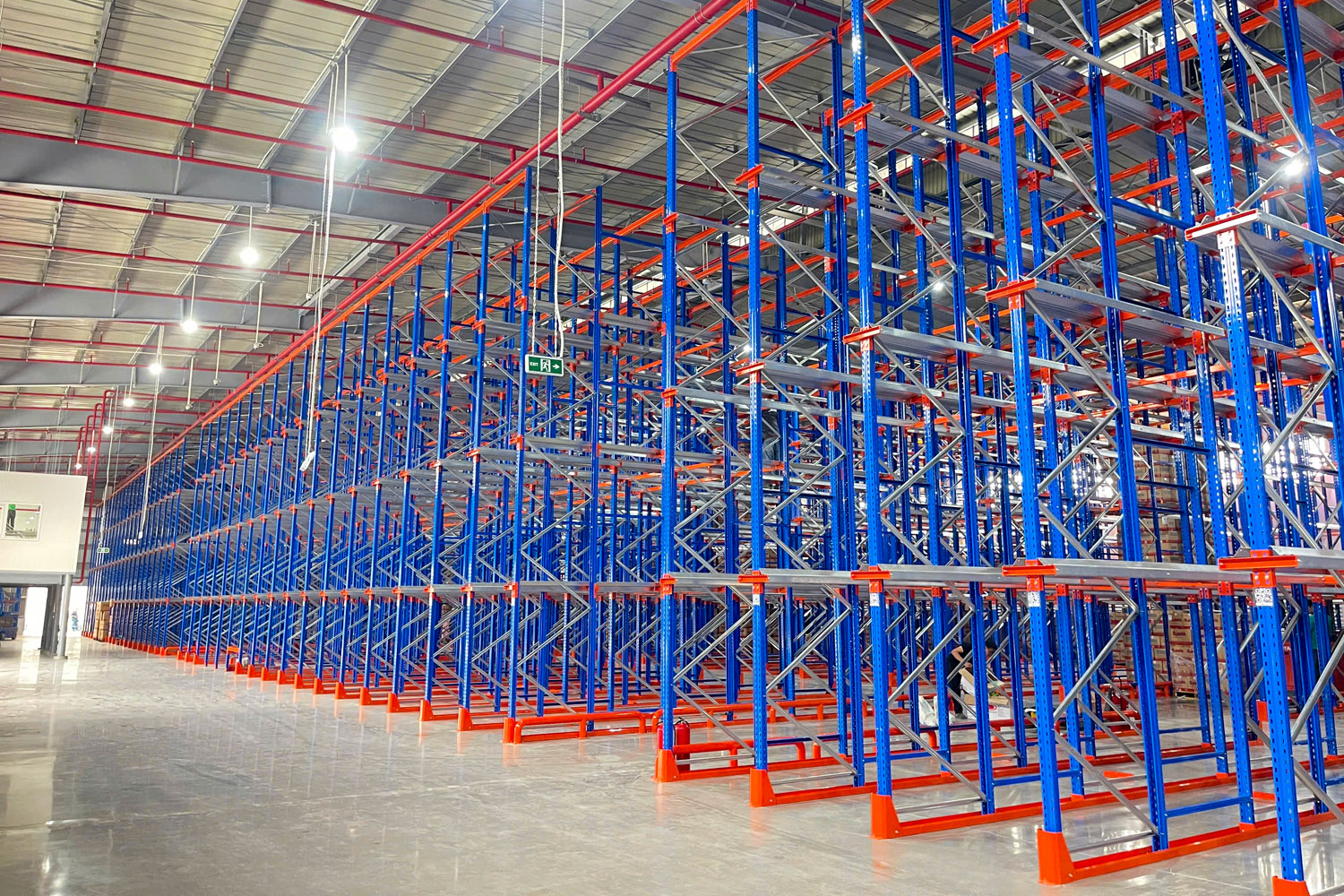
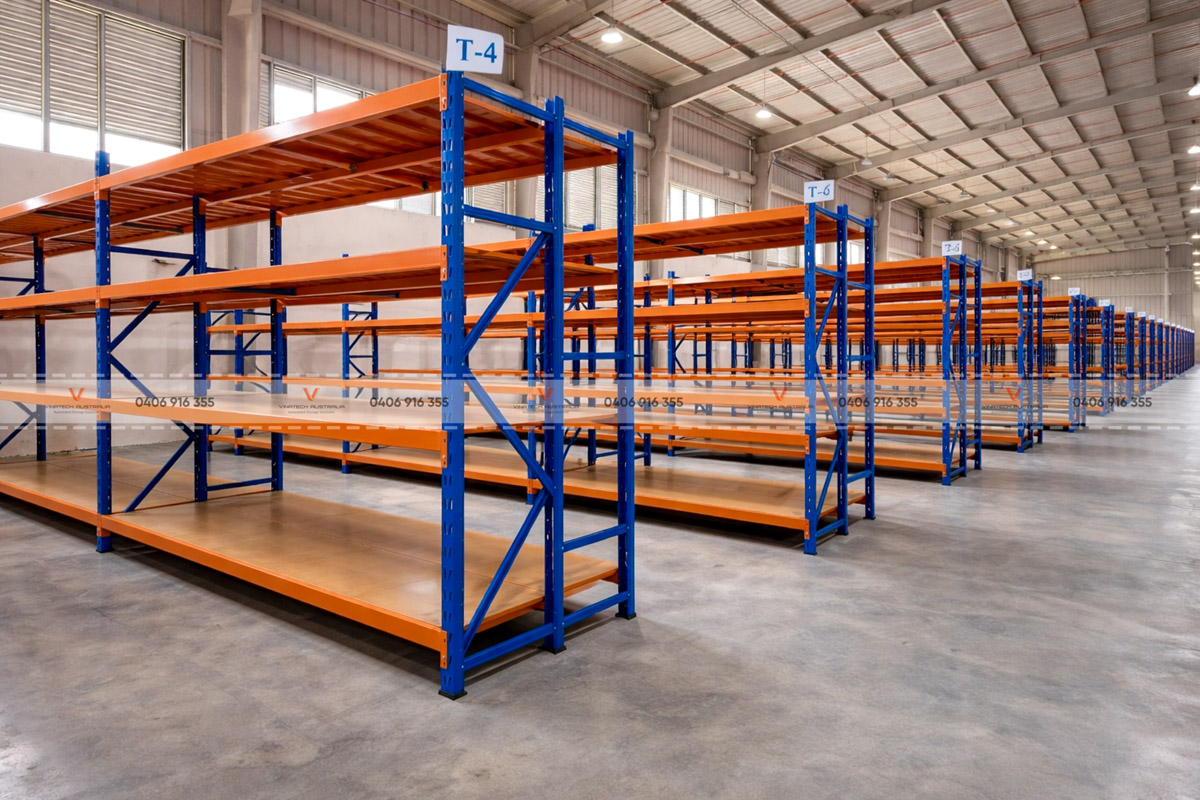
7 Types of Industrial Warehouse Racking
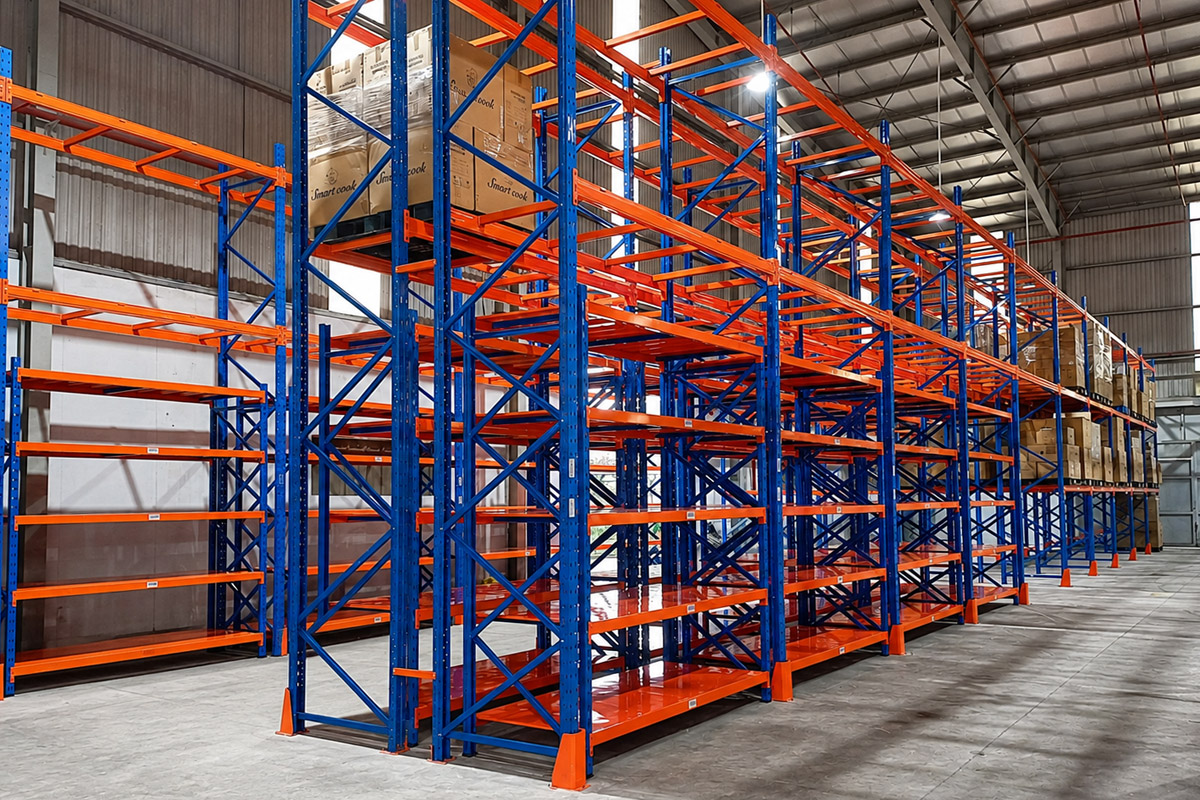
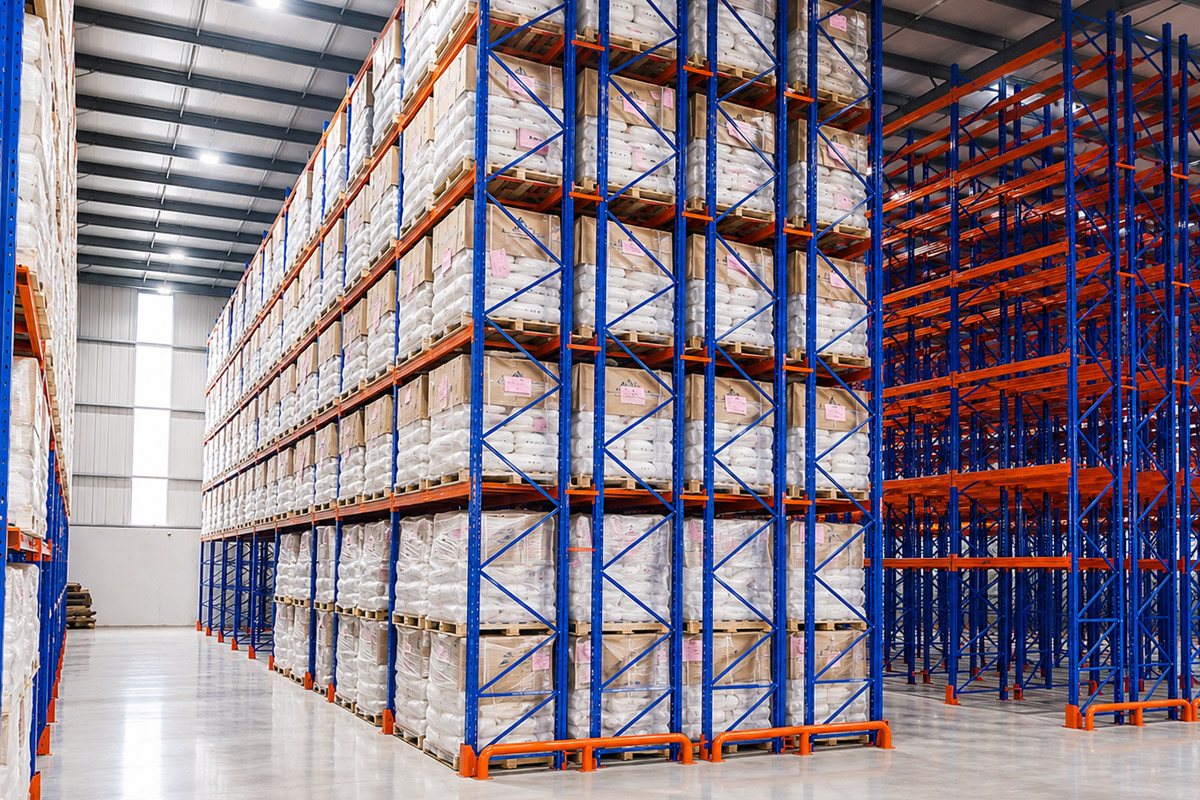
7 types of industrial warehouse racking include Selective Rackin, Heavy Duty Shelving, Double Deep Racking, Drive-in Racking, Pallet Flow Racking, Warehouse Racking Mezzanine, and Very Narrow Aisle (VNA) Racking. Each system offers different advantages in terms of storage capacity, pallet accessibility, inventory management, and warehouse space utilisation, making it important to select the right solution for your operational needs.
Selective Racking System
Selective pallet racking provides direct access to every pallet position without moving neighbouring loads. It suits warehouses handling many stock keeping units (SKUs) and frequent individual pallet retrieval.
Upright frames and adjustable beams accommodate different load heights within the approved configuration. Clearly labelled locations simplify picking and stock checks.
- Best for: Mixed inventory and frequent access.
- Main advantage: Direct pallet accessibility.
- Consideration: Requires more aisle space than deeper storage systems.

Heavy Duty Shelving
Heavy duty shelving stores cartons, tools, components and other non-palletised goods on load-bearing shelves. It suits workshops, spare parts stores and warehouse areas where individual items are picked by hand.
Longspan shelving can also support carton and component storage. Shelf dimensions and rated capacities must match the goods and loading pattern.
- Best for: Hand picking and non-palletised stock.
- Main advantage: Accessible, organised item storage.
- Consideration: Heavy goods may require handling assistance.

Double Deep Racking
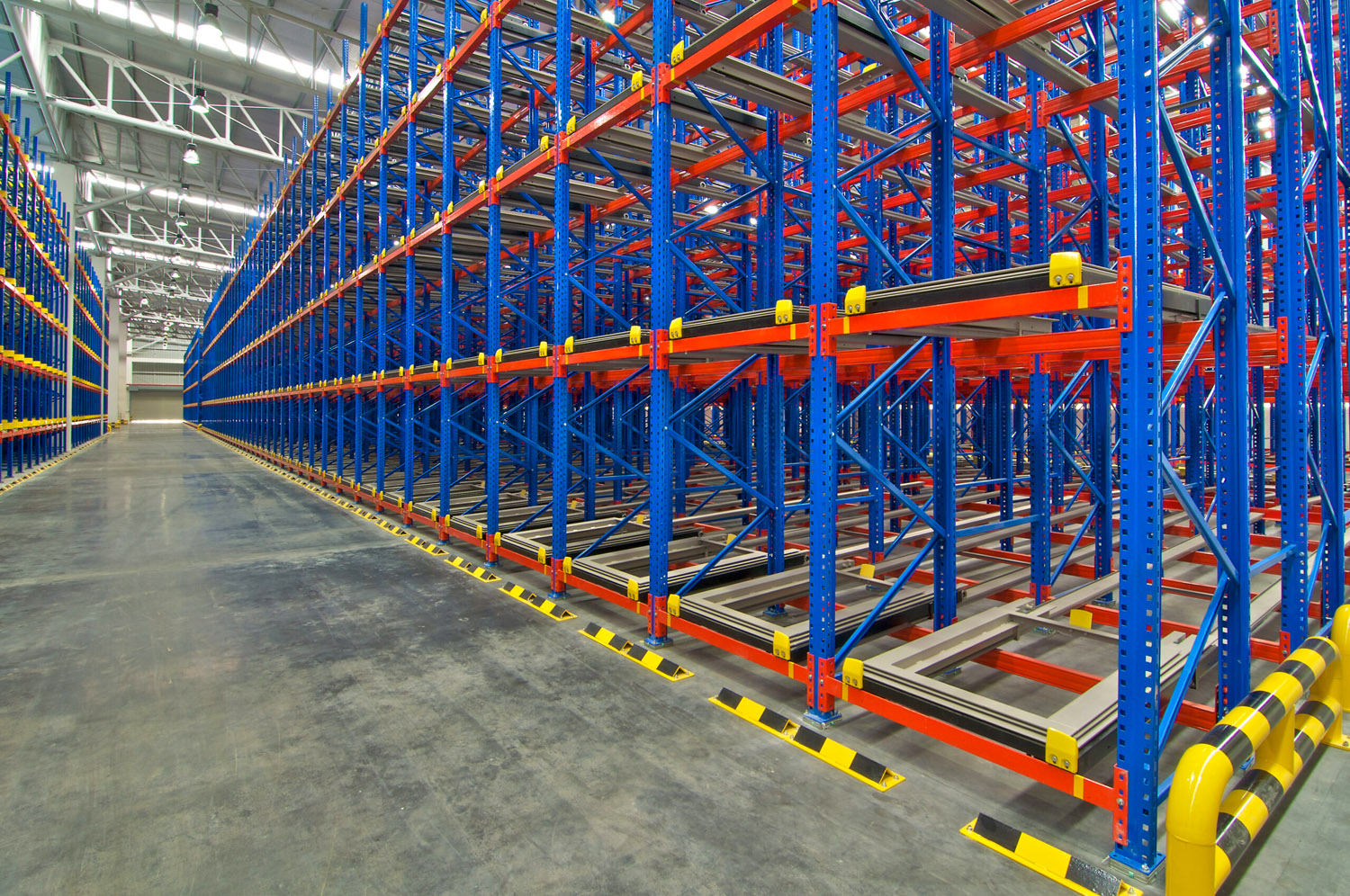
Double deep pallet racking stores pallets two positions deep, reducing the number of access aisles needed. It suits businesses holding several pallets of the same SKU.
The front pallet must be removed before accessing the rear pallet. This arrangement commonly follows LIFO within each pair and requires suitable deep-reach equipment.
- Best for: Repeated pallet quantities.
- Main advantage: Higher storage density.
- Consideration: Reduced direct access to rear pallets.

Drive-in Racking
Drive-in pallet racking uses deep storage lanes that forklifts enter to place and retrieve pallets. It suits large quantities of relatively few products.
Standard drive-in systems load and unload from the same entrance, generally supporting LIFO operation. Careful lane allocation helps prevent partly filled lanes from reducing usable capacity.
- Best for: Bulk storage of similar goods.
- Main advantage: Compact pallet storage.
- Consideration: Limited access to individual pallets within a lane.

Pallet Flow Racking
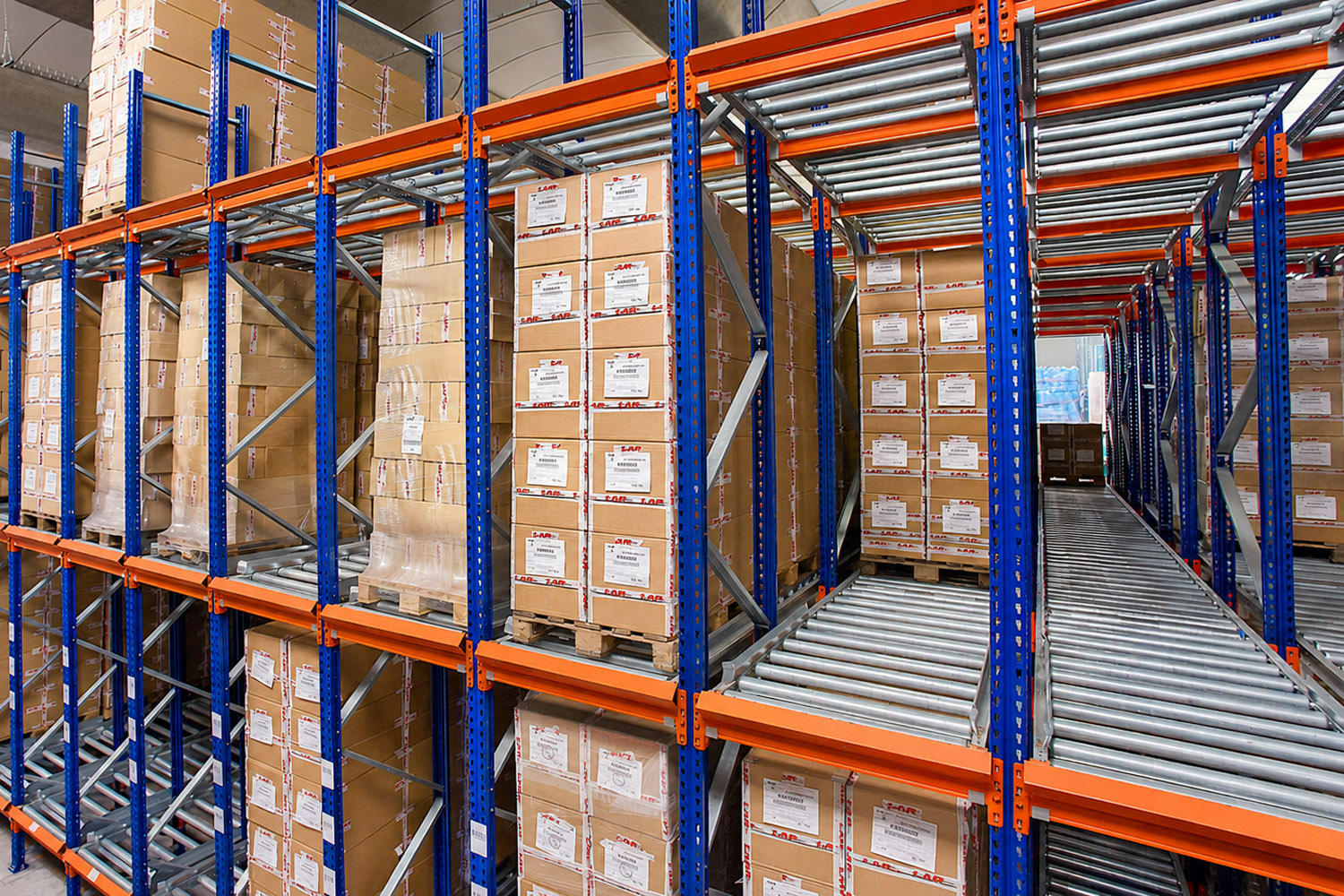
Pallet flow racking moves pallets along inclined roller lanes from the loading side towards a separate retrieval side. This supports FIFO movement within each lane.
The rollers, braking arrangement and lane configuration must suit the pallet construction and loaded weights. Expiry-based picking also requires appropriate inventory records and allocation.
- Best for: Repeated pallet movements and FIFO stock rotation.
- Main advantage: Separate replenishment and retrieval faces.
- Consideration: Pallet compatibility is essential.

Warehouse Racking Mezzanine
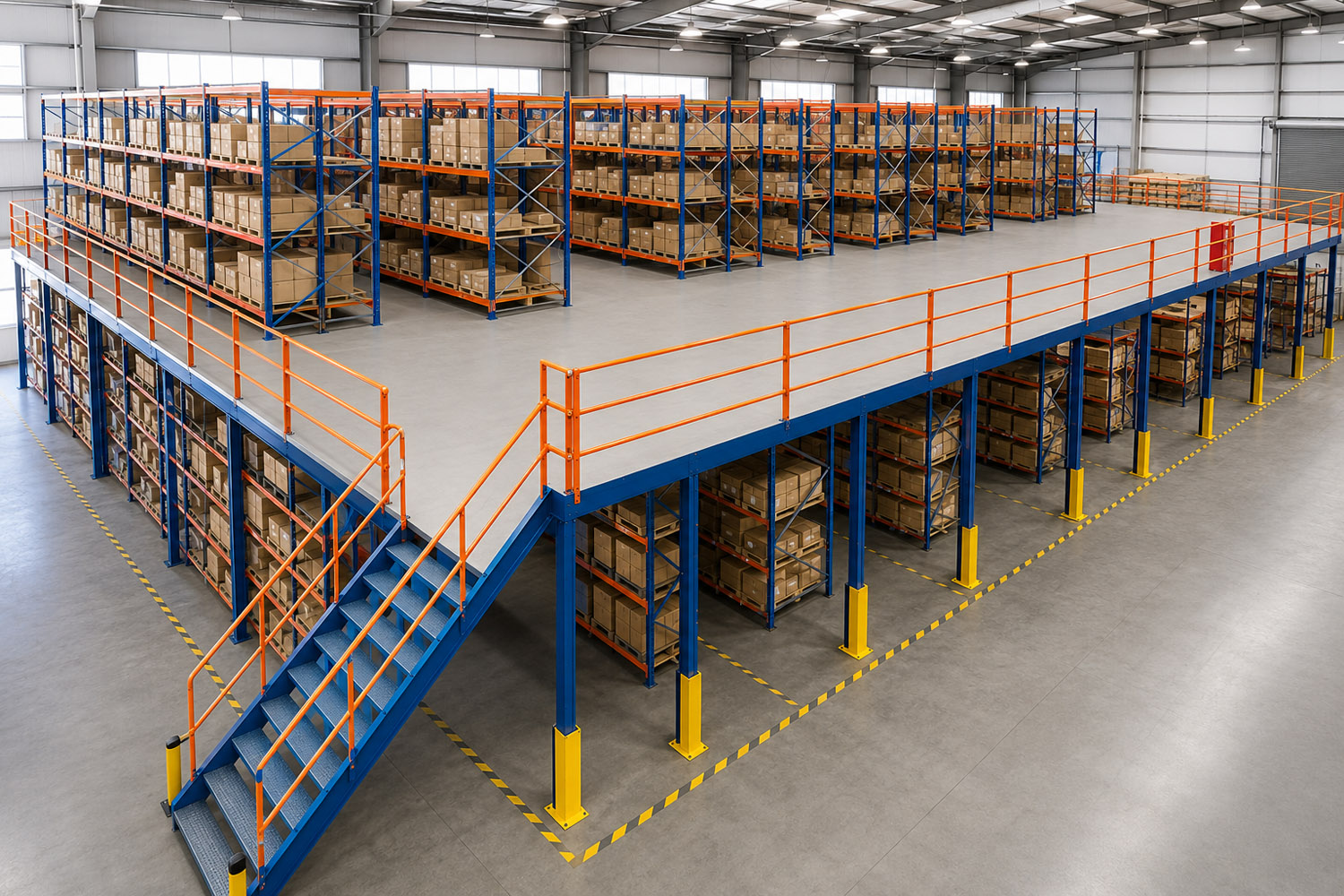
A warehouse racking mezzanine creates an additional usable level supported by a designed racking structure. It can provide extra storage or picking space within a building with sufficient clear height.
Planning must account for floor loads, access, guarding and movement of goods between levels.
- Best for: Facilities needing additional usable space.
- Main advantage: Better use of building height.
- Consideration: The extra level must fit the operational workflow.

Very Narrow Aisle Racking (VNA)
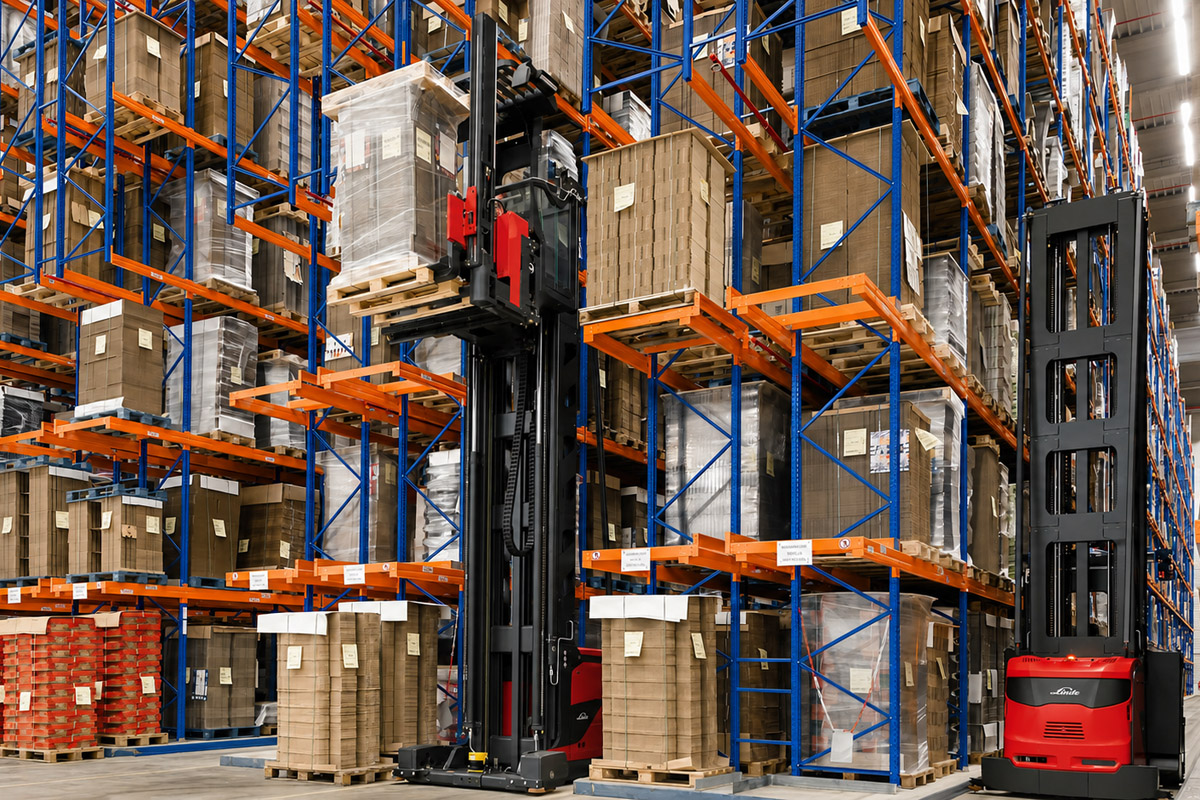
VNA racking combines narrow aisles with direct access to individual pallet positions. It suits warehouses seeking higher density while retaining access to varied SKUs.
The racking, specialised truck and floor requirements must be planned together.
- Best for: High-capacity storage with direct pallet access.
- Main advantage: Less floor space dedicated to aisles.
- Consideration: Requires compatible equipment and operating conditions.

Benefits of Industrial Warehouse Racking
Industrial warehouse racking improves usable capacity, organises material flow and establishes defined storage locations. These benefits are strongest when the layout matches daily warehouse activities.
Maximising warehouse space and storage capacity
Storage racks use both floor area and building height to accommodate goods across multiple levels. Suitable configurations can reduce scattered floor storage and provide additional pallet or shelf locations.
Measure capacity using positions that fit your actual goods, while retaining enough space for receiving, dispatch and handling.
Improving operational efficiency and workflow
Warehouse racking and shelving help workers locate, replenish and retrieve stock more efficiently. Clear location labels and logical product placement reduce unnecessary searching and movement.
Combining reserve pallet storage with accessible shelving for hand picking can also separate bulk replenishment from individual order preparation.
Enhancing safety and load management
Defined storage positions help teams manage goods within the system’s approved operating limits. Accurate pallet weights, suitable load placement and clear procedures support consistent use.
Review changes in packaging, pallet dimensions or quantities before assigning new loads to existing locations.

How to Choose the Right Industrial Warehouse Racking
Choosing the right industrial warehouse racking system requires careful consideration of factors such as warehouse layout and available space, load weight, pallet type and SKU profile, as well as material handling equipment and forklift compatibility.
Warehouse layout and available space
Warehouse layout directly impacts material flow, storage density, and operational efficiency. Common layouts include:
- U-shaped layout: inbound and outbound on the same side, reducing travel distance
- I-shaped layout: straight-through flow with receiving and dispatch at opposite ends
- L-shaped layout: suited to constrained or irregular building footprints
Load weight, pallet type, and SKU profile
Each warehouse racking system is engineered with specific load limits per level and frame. Accurately defining load weight and distribution is critical for safety and durability.
Pallet type (wood, plastic, or steel), pallet dimensions, and SKU diversity directly influence beam configuration, upright spacing, and forklift compatibility.

Material handling equipment and forklift compatibility
Racking must match the equipment’s access requirements and lifting capability. Confirm the actual forklift, pallet stacker or walkie stacker specification for the intended loads and storage heights.
Double deep and VNA systems require appropriate specialised capability. Include turning and transfer areas when planning aisle space.
Safety Standards and Compliance in Australia
Safe and compliant industrial warehouse racking in Australia depends on meeting AS 4084 requirements, using appropriate load signage, protection and safety accessories, and carrying out regular racking inspections.
AS4084 requirements for industrial warehouse racking
Industrial warehouse racking structures are inherently high-risk due to the storage of heavy loads at height. If not properly designed, installed, and maintained, the likelihood of accidents increases significantly. The updated AS4084:2023 standard places strong emphasis on:
- Improved structural durability
- More rigorous inspection procedures
- Clearer operational and safety guidelines
Compliance with AS 4084 enhances workplace safety, reduces the risk of structural failure and equipment damage, and minimises legal exposure. As such, AS 4084 is a fundamental requirement for any warehouse racking system operating in the Australian market.
Load signage, protection, and safety accessories
Load signage, rack protection, and safety accessories are essential components of a safe industrial warehouse racking environment. Clearly displayed load ratings help prevent overloading, while protective barriers, column guards, and impact protection reduce damage from forklift operations.
Equipping warehouse pallet racking with appropriate safety accessories not only ensures compliance with safety standards but also extends the service life of the warehouse racking system and minimises operational risk.

Importance of regular racking inspections
Regular inspections are critical to maintaining the safety and long-term performance of industrial warehouse racking. Over time, racking structures may be affected by forklift impacts, incorrect loading practices, or material fatigue.
Routine inspection programs help identify damage early, allowing corrective actions before structural stability is compromised. This proactive approach ensures continuous safe operation of the warehouse racking system and reduces the risk of costly downtime or accidents.
Vinatech Australia: Industrial Warehouse Racking – Automated Warehouses Solutions
- Phone number: 0485 083 868
- Email: info@vinatech.com.au
- Address: 34 Paramount Bvd, Cranbourne West VIC 3977
FAQ
What types of industrial warehouse racking are available?
This guide covers seven storage solutions: selective pallet racking, heavy duty shelving, double deep racking, drive-in racking, pallet flow racking, warehouse racking mezzanines, and very narrow aisle (VNA) racking. Each suits different goods and handling requirements.
What is the difference between pallet racking and industrial shelving?
Pallet racking stores palletised goods typically handled by forklifts. Industrial shelving supports individual items, cartons, tools, and components, usually accessed by hand. Many warehouses combine both systems for bulk storage and order picking.
How do I choose the right warehouse racking system?
Consider pallet dimensions and weights, SKU variety, stock rotation, available space, and forklift specifications. Selective racking prioritises direct access, while double deep and drive-in systems provide denser storage with reduced pallet accessibility.
How much weight can industrial warehouse racking hold?
Load capacity depends on the beams, upright frames, configuration, and approved design. Check the rated limits for each pallet position, beam level, and bay. There is no single capacity that applies to all heavy duty racking systems.
How much does industrial warehouse racking cost?
Cost depends on the racking type, storage capacity, dimensions, load requirements, accessories, and installation scope. For an accurate quotation, provide your warehouse floor plan, pallet details, handling equipment specifications, and target number of storage positions.
Which Australian standards apply to warehouse pallet racking?
The AS 4084:2023 series includes AS 4084.1:2023 for steel storage racking design and AS 4084.2:2023 for operation and maintenance. Ask your supplier to confirm the applicable requirements and provide documentation for your specific installation.
How often should warehouse racking be inspected?
SafeWork NSW guidance specifies formal inspections by a competent person at intervals not exceeding 12 months. Routine checks should also be carried out, and any damage should be reported immediately for assessment.
How can I request a warehouse racking quote from Vinatech Australia?
Send your warehouse location, floor plan, pallet dimensions, loaded weights, and required storage capacity to [info@vinatech.com.au](mailto:info@vinatech.com.au), or call 0485 083 868. Include your existing forklift details to help identify a suitable racking layout.

William Harris is the Production Director at Vinatech Australia, with more than 10 years of experience in industrial warehouse racking, manufacturing, warehouse optimisation and smart storage technologies. His professional background combines engineering, production management and warehouse operations, enabling him to oversee the development of storage systems designed for safety, durability, efficiency and long-term operational performance.