



Pallet rack weight capacity is a critical factor in ensuring the safety and efficiency of warehouse storage systems. Understanding load limits helps businesses select the right racking configuration, optimize storage space, and reduce operational risks. It also plays an essential role in meeting safety standards and maintaining long-term warehouse performance.
What is Pallet Rack Weight Capacity?
Pallet racking systems play a critical role in the safe and efficient storage of goods across warehouses, retail distribution centres, and industrial facilities in Australia. Before investing in or installing any pallet racking system, businesses must ensure that the entire structure, including beams, upright frames, and connections can safely support the intended loads.
As a result, accurately assessing warehouse racking weight capacity is essential to maintaining workplace safety, regulatory compliance, and long-term operational efficiency.
Pallet rack weight capacity refers to the maximum load a pallet racking system can safely support under normal operating conditions. This capacity is not a fixed value and varies depending on several factors, including the racking type, rack dimensions, beam length, steel grade, upright profile, and compliance with applicable Australian design and safety standards.
In practice, pallet racking weight is specified at three critical levels:
- Beam load capacity, which defines how much weight a single beam pair can support.
- Pallet position load capacity, which determines the allowable weight per pallet position.
- Frame or bay load capacity, which represents the total allowable load supported by the upright frames.
These load ratings are established through engineering calculations and structural testing, taking into account material strength, design configuration, and defined racking weight limits.

Why Is It Important to Understand Pallet Rack Weight Capacity?
Pallet rack weight capacity is a critical consideration when designing, upgrading, or expanding a warehouse layout. When racking systems are subjected to loads beyond their rated racking weight capacity, structural components such as beams and upright frames may deflect, deform, or progressively weaken.
In practice, standard selective pallet racking systems typically support loads ranging from approximately 500 kg to 3,000 kg per level, while heavy-duty pallet racking systems can exceed 3,000 kg per level, depending on configuration.
Selecting an incorrect load rating or exceeding allowable racking weight limits can result in beam deflection, rack instability, and an elevated risk of serious warehouse incidents. Understanding and correctly applying pallet rack weight capacity also helps businesses to:
- Avoid risks arising from uneven load distribution and the natural deterioration of racking systems over time.
- Prevent mismatches between the racking system and the type of goods being stored.
If these factors are not properly controlled, they can directly compromise employee safety and disrupt warehouse operations.
Risks of Overloading Pallet Racking Structures
Placing loads that exceed the design limits of pallet racking systems is one of the most common causes of warehouse incidents. These risks not only compromise the structural integrity of the racking system but also have a direct impact on workplace safety, operational efficiency, and long-term costs for businesses.
Workplace Safety Risks and the Potential for Rack Collapse
When pallet racks are exposed to loads beyond their rated pallet rack weight capacity, structural elements such as beams and upright frames may gradually deflect, crack, or permanently deform.
In severe cases, this can lead to rack collapse, posing a serious danger to warehouse staff, particularly in high-traffic areas involving forklifts and pallet handling equipment. Racking failures can result in personal injury, product loss, legal liability, and costly operational downtime.
Reduced Operational Efficiency and Increased Long-Term Costs
Beyond safety concerns, exceeding racking weight limits can significantly reduce warehouse efficiency. Deformed or misaligned racking restricts pallet movement, slows down picking and replenishment activities, and increases the likelihood of product damage.
Over time, businesses may face higher maintenance costs, frequent repairs, or premature replacement of racking systems, leading to increased capital expenditure and reduced reliability within the supply chain.
How to Determine Pallet Rack Weight Capacity
Accurately determining pallet rack weight capacity is essential to ensuring that a storage system operates safely, sustainably, and in line with business storage requirements. Warehouse racking weight capacity is influenced by multiple structural, design, and operational factors rather than a single numeric value.
Steps to Calculate Pallet Racking Load Capacity
To correctly assess pallet racking weight, businesses should calculate capacity at each load level instead of relying on assumptions:
- Identify the maximum weight of a fully loaded pallet, including both the pallet and stored goods.
- Determine the number of pallets per beam level.
- Calculate the total load per level by multiplying pallet weight by the number of pallet positions.
- Add together the loads of all beam levels to determine the total load per rack bay.
- Review load distribution carefully. Pallets must be evenly positioned on beams, as uneven or off-centre loading can significantly reduce actual load capacity compared to the rated racking weight capacity.
Tools and Load Charts Used to Determine Capacity
Calculating pallet rack weight capacity must be based on accurate technical data rather than assumptions. The most important reference is the load chart provided by the manufacturer, which clearly specifies the load capacity of beams and upright frames for different lengths, profiles, and installation configurations.
Technical drawings and product catalogues further detail steel grade, material thickness, connection types, and corresponding racking weight limits, all of which are essential when designing or modifying a warehouse racking system.
How to Increase Pallet Racking Storage Capacity
Increasing pallet racking storage capacity allows warehouses to optimise space utilisation while maintaining safety and compliance with rated load limits. Increasing pallet racking capacity helps warehouses optimize space, improve efficiency, and support future growth.
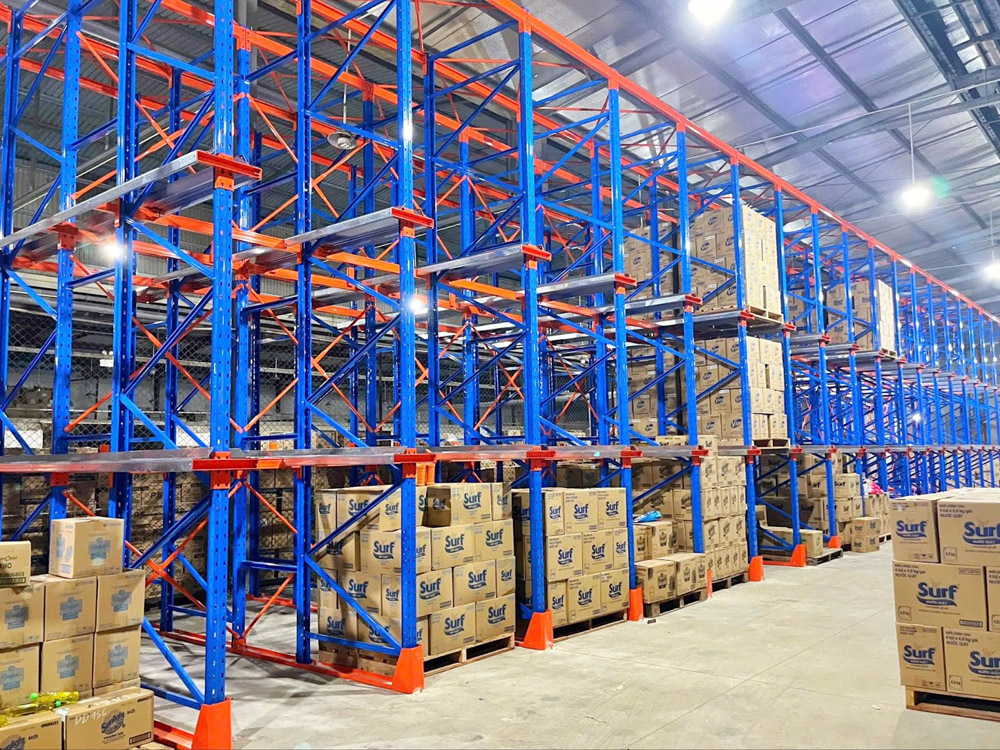
Solutions such as double-deep racking or high-density storage systems, including Drive-in racking, push back racking and pallet flow racking, allow warehouses to store more pallets within the same floor area by reducing aisle space or increasing storage depth. These systems provide a higher number of pallet positions compared to selective racking while maintaining practical operational access.
Making use of available warehouse height is another effective way to increase storage capacity. If ceiling height allows, businesses can add additional beam levels to existing racking frames, provided that the load on each rack bay remains within the specified pallet rack weight capacity.
Frequently Asked Questions About “Pallet Rack Weight Capacity”
Can I change the racking configuration without affecting load capacity?
No. Modifying racking configurations, such as adding beam levels or increasing beam length can alter the overall racking weight capacity. Any changes should be reviewed against manufacturer specifications or assessed by a qualified racking designer or structural engineer.
Is pallet rack weight capacity calculated based on evenly distributed loads?
Yes. Load ratings are typically based on the assumption that weight is evenly distributed across beams and rack bays. If loads are unevenly distributed or concentrated on one side, the actual load-bearing capacity of the racking system may be reduced, increasing the risk of structural damage.
Are there safety standards or regulations that must be followed when determining pallet rack weight capacity?
Yes. Pallet racking systems must comply with relevant safety and design standards applicable in Australia and other regions. Adhering to these standards ensures compliance with allowable racking weight limits, reduces risk, and protects both personnel and assets.
Vinatech Australia: Industrial Warehouse Racking – Warehouse Shelving Solutions
- Website: https://vinatech.com.au/
- Phone number: 0406 916 355
- Email: info@vinatech.com.au
- Address: 34 Paramount Bvd, Cranbourne West VIC 3977

My name is William Harris, and I am the Production Director at Vinatech Australia. I oversee the entire manufacturing operation for our industrial warehouse racking systems and the development of smart warehouse solutions.