


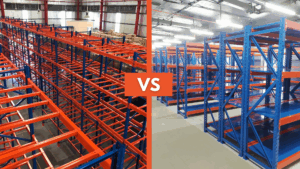
A well-organized warehouse can quickly respond to customer demands and significantly improve overall company performance. Depending on product characteristics, warehouse size, and operational frequency, businesses can opt for Heavy Duty Racking, ideal for palletized and heavy goods or Longspan Shelving, which offers greater flexibility for hand-loaded items and medium-weight storage needs.
What is Heavy Duty Racking?
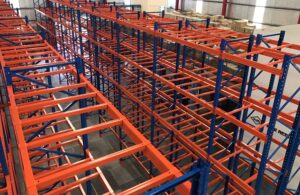
Heavy Duty Racking, also known as pallet racking, is a robust storage system designed to hold large, stacked goods and heavy materials commonly found in industrial warehouses and distribution centers. This system provides a strong, well-organized structure that allows forklifts to easily load and unload pallets, thereby enhancing both storage density and workflow efficiency.
Construction and Load Capacity
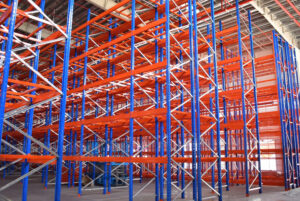
Designed for strength and adaptability, Heavy Duty Racking can be customized to suit a wide range of warehouse layouts and product types — from bulk storage to high-bay operations. Its modular design allows adjustments in height, width, and bay configuration to accommodate different product dimensions and spatial arrangements.
This system is particularly ideal for facilities managing large-volume or heavy-weight inventory, where safety and structural stability are top priorities thanks to its resistance to bending and deformation.
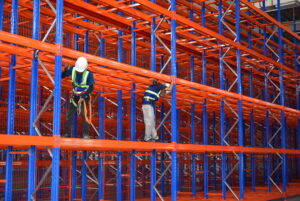
Made from high-strength steel, each rack includes reinforced uprights and beams capable of supporting hundreds to thousands of kilograms per pallet. Rigid cross bracing and secure locking systems provide maximum stability, preventing bending or movement under heavy loads.
Advantages and Limitations
⇒ Advantages
- High Storage Density
Maximizes both vertical and horizontal space, allowing businesses to store more goods without expanding the warehouse footprint. The use of this pallet racks enables efficient layout planning, systematic organization, and optimal utilization of every square meter of storage space.
- Outstanding Load Capacity
Constructed from high-strength steel, heavy duty racking systems can support extremely heavy, bulky, or large-scale palletized goods, ensuring maximum safety and structural stability throughout long-term use.
Reinforced frames, beams, and joints secured through specialized welding or bolted connections, maintain superior load-bearing performance even under harsh industrial conditions such as manufacturing plants, cold storage facilities, and high-traffic logistics centers.
- Efficient inventory handling:
Fully compatible with forklifts, pallet jacks, and warehouse automation systems, heavy duty racking allows for faster, safer, and more precise loading, stacking, and movement of goods. Its open structure and standardized dimensions provide easy pallet access, reducing handling time and minimizing collision risks.
When integrated with Warehouse Management Systems (WMS) or automated equipment such as AGVs and ASRS, inventory handling efficiency increases significantly, ensuring continuous stock flow, accurate inventory tracking, and optimized overall warehouse performance.
⇒ Limitations
- Limited Selectivity
Accessing individual pallets can be challenging in high-density configurations, requiring businesses to carefully categorize and organize inventory to prevent congestion during loading and unloading operations.
- Space Constraints
Not ideal for warehouses with limited floor space or low ceilings, where vertical storage capacity cannot be fully utilized. Aisles between rack rows must be wide enough for forklifts to maneuver safely, which can reduce the actual usable storage area in smaller facilities.
»» Read more: Selective Pallet Racking vs Double Deep Racking
What is Longspan Shelving?
Longspan Shelving is an ideal solution for areas that don’t require the heavy load capacity of pallet racking. It provides spacious storage on a compact footprint, simplifying the organization of bulky items. Combining strength and convenience, it allows businesses to manage inventory efficiently without the need for heavy equipment.

Design Features and Load Handling
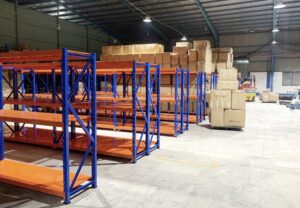
Longspan Shelving is a versatile and durable storage system designed for medium to heavy-duty applications across various facilities. Unlike pallet racking, which relies on forklifts, it’s built for manual handling, ideal for storing cartons, tools, spare parts, and irregularly shaped items.
Made from high-strength steel with reinforced uprights and beams, it ensures excellent stability. The adjustable shelf levels (typically 50–75 mm apart) allow users to maximize space efficiency and adapt to different product sizes.
Advantages and Limitations
⇒ Advantages
- High Flexibility
Shelf levels can be easily adjusted to accommodate different product sizes and heights. The system’s high-quality steel frames and beams ensure durability while remaining lightweight, making installation, relocation, and future expansion simple. Its open design provides easy product access, allowing staff to handle items manually with greater speed and efficiency.
- Cost-Effective Solution
This is a more economical alternative to pallet racking systems, providing clean, tidy and aesthetically pleasing storage space. With a balance of durability, flexibility and affordability, it’s the ideal solution for businesses looking to maximize storage efficiency while maintaining operational flexibility.
- Lightweight yet Durable
Constructed from high-strength steel, the shelving combines durability with a lightweight structure. It can be moved within the warehouse without compromising stability, with each level typically supporting up to 600 kg of evenly distributed load.
⇒ Limitations
- Space Requirements
Although Longspan Shelving maximizes horizontal space, it may not fully utilize vertical height, making it less suitable for high-ceiling warehouses that require vertical stacking. As storage volume grows, manual handling and item retrieval can become less efficient, especially in facilities with high turnover rates.
- Weight Capacity Constraints
Despite being designed for medium to heavy-duty use, Longspan Shelving is not intended for extremely heavy or oversized industrial goods. It’s unsuitable for storing large pallets or very heavy items that require forklift handling.
»» Read more: Longspan Shelving
Cost, Durability, and Maintenance Considerations
When choosing between these rackings, businesses must consider not only storage capacity and space utilization but also investment costs, durability, and long-term maintenance expenses.
Budget Implications
In terms of budget, Longspan Shelving offers a cost advantage due to its simple structure, easy installation, and minimal component requirements. It is a cost-effective solution for businesses storing medium-weight, small-sized, or irregularly shaped goods.
Conversely, Heavy Duty Racking requires a higher upfront investment because it uses thicker steel and more complex load-bearing designs. However, it delivers long-term value with stable performance over many years and minimal replacement needs.
When planning investments, businesses should evaluate the total cost of ownership (TCO), including installation, maintenance, operational efficiency, and payback period. The ideal system is one that meets current storage needs while aligning with the company’s budget and long-term growth strategy.
Longevity and Safety
Durability and safety are key factors determining the lifespan and operational performance of both. Although both systems are designed to maintain structural stability over time, their real-world performance depends on material quality, usage conditions, and regular maintenance practices.
Modern racking systems are built from high-strength carbon steel with powder-coated finishes to resist rust and wear. Heavy Duty Racking can last 10–20 years with proper installation and maintenance, while Longspan Shelving, though lighter, stays durable with cross-bracing and replaceable components.
For safety, businesses should perform regular inspections to detect damage or corrosion early, ensure even load distribution, and maintain safe spacing between rack levels and forklift aisles to prevent collisions and maintain stability.
Choosing the Right Storage Solution for Your Needs
Choosing the right storage system is crucial for optimizing warehouse space, improving operational efficiency, and reducing costs. Both offer distinct advantages, but businesses should carefully assess product characteristics, load requirements, turnover frequency, and warehouse layout before making a decision.
Heavy Duty Racking is ideal for large warehouses or manufacturing facilities storing heavy, high-volume goods, while Longspan Shelving is better suited for manual handling areas that require flexibility and quick access.
Assessing Storage Requirements
Choosing an effective warehouse storage solution begins with an assessment of product characteristics and operational needs. It is important to determine whether the goods are palletized or not to decide whether to use Heavy Duty Racking or Longspan Shelving.
If goods are frequently moved or accessed, Longspan Shelving with its open design and easy accessibility provides higher efficiency. Conversely, for bulk or long-term storage, high-density racking systems help save space and optimize vertical capacity.
Factors such as warehouse layout (floor space, ceiling height, and aisle configuration) and material handling methods – manual, forklift, or automated – play a key role in the decision-making process.

Maximizing Warehouse Efficiency
To optimize space, businesses should make full use of vertical height by implementing multi-tier racking systems or combining different rack types for specific zones. Heavy Duty Racking is ideal for palletized and heavy goods stored on higher levels, while Longspan Shelving is well-suited for lighter items or accessories at lower levels.
To improve workflow efficiency, shelves should be organized properly – from receiving, storage to shipping – to reduce travel time and avoid congestion. Furthermore, classifying products by rotation speed (fast, medium and slow) helps improve picking speed and minimize errors in processing.
When designed and operated correctly, a storage system not only boosts productivity but also lowers operating costs and safety risks, creating a modern, efficient, and sustainable warehouse environment.
Making the Best Choice Between Heavy Duty Racking and Longspan Shelving
Heavy Duty Racking is ideal for large warehouses, logistics centers, and factories storing heavy, palletized goods. It offers high durability, large capacity, and long-term performance, but requires greater investment and space.
Longspan Shelving, on the other hand, provides flexibility, easy access, and cost efficiency, making it perfect for medium or small warehouses handling lighter goods and frequent manual operations.
The best approach is to choose based on product type, load, usage frequency, and warehouse size or combine Heavy Duty Racking for heavy loads with Longspan Shelving for lighter items to balance capacity, cost, and efficiency.
Why choose Vinatech Australia?
Vinatech Australia is a trusted partner in warehouse storage and space optimization solutions, providing international-standard products and professional consulting services. With years of experience, Vinatech delivers comprehensive, safe, and cost-effective storage solutions tailored to every business need.
With a vision to become Australia’s leading provider of storage solutions, Vinatech Australia not only supplies high-quality products but also partners with businesses on their journey to build smarter, safer, and more efficient warehouses.
𝐕𝐢𝐧𝐚𝐭𝐞𝐜𝐡 𝐀𝐮𝐬𝐭𝐫𝐚𝐥𝐢𝐚 – 𝐒𝐦𝐚𝐫𝐭 𝐖𝐚𝐫𝐞𝐡𝐨𝐮𝐬𝐞 𝐒𝐨𝐥𝐮𝐭𝐢𝐨𝐧𝐬
- Website: https://vinatech.com.au/
- Phone number: 0406 916 355
- Email: info@vinatech.com.au
- Address: 48/58 Cyber Loop, Dandenong South VIC 3175, Australia

My name is William Harris, and I am the Production Director at Vinatech Australia. I oversee the entire manufacturing operation for our industrial warehouse racking systems and the development of smart warehouse solutions.