



FIFO (First In, First Out) has become a cornerstone of efficient inventory management. By ensuring that the oldest stock is sold or used first, this method not only helps businesses minimize waste, spoilage, and obsolescence but also enhances financial accuracy and operational transparency.
What is FIFO: Definition and Basics
FIFO (First In, First Out) is an inventory management method in which the items that are received first are also the first to be sold or used. This principle ensures that goods move through the supply chain in a logical and orderly manner, minimizing the risk of products becoming outdated, expired, or damaged due to prolonged storage.
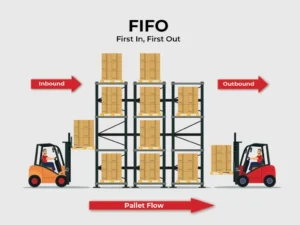
To implement FIFO effectively, businesses need to monitor and record inventory levels regularly, keeping accurate track of stock quantities to plan timely replenishments from suppliers. A well-organized inventory management system enables controlled, systematic, and transparent inbound and outbound processes, thereby optimizing warehouse efficiency and overall operational performance.
FIFO vs Other Inventory Methods
FEFO (First Expired, First Out), FIFO (First In, First Out), and LIFO (Last In, First Out) are three main inventory management methods applied across different industries, each with its own advantages, limitations, and suitable applications.

| FIFO (First In, First Out) | FEFO (First Expired, First Out) | LIFO (Last In, First Out) | |
| Operate | Goods received first are issued or sold first. | Products with the earliest expiration dates are dispatched first. | Prioritizes the most recently received goods for use or distribution. |
| Advantages | – Enables logical product flow
– Ensures product freshness – Minimizes long-term stockholding |
– Ensures compliance with GMP/GDP regulations
– Maintains product quality throughout the supply chain – Reduces risk of product obsolescence and waste |
– Can help save costs in some industries
– Simple to apply for fast-moving inventory |
| Disadvantages | – Not ideal for products without clear expiry or turnover cycles
– Limited application in pharmaceuticals |
– Higher operational complexity requiring advanced tracking systems
– Higher cost due to warehouse management system (WMS) needs |
– Not suitable for products with expiry dates
– Incompatible with pharmaceutical standards – Non-compliant with GMP/GDP due to poor expiry tracking |
| Application | Best suited for perishable goods such as food, pharmaceuticals, and chemicals | Ideal for food, pharmaceutical, and chemical industries | Rarely used in practice and unsuitable for perishable goods; may apply to packaging materials or labeling supplies |
⇒ When to Apply FIFO:
The FIFO method is most suitable for businesses handling perishable or time-sensitive products. Applying FIFO ensures that goods move in the correct sequence, minimizing the risk of aging inventory, improving inventory turnover, and accurately reflecting the real value of stock in financial records.
Importance of FIFO in Inventory Management
In inventory management, FIFO (First In, First Out) is not only a principle for stock rotation but also a fundamental approach that enables businesses to operate more efficiently and sustainably.
Benefits of Applying FIFO
This method helps businesses manage inventory effectively while bringing significant benefits to both product quality and financial performance.
⇒ Reducing waste and spoilage:
By ensuring that older stock is sold or used first, FIFO helps minimize the risk of products remaining in storage for too long, thus reducing the likelihood of damage, expiration, or obsolescence, a critical factor for industries dealing with food, pharmaceuticals, or chemicals.
⇒ Ensuring product freshness and brand reputation
Proper stock rotation guarantees that products delivered to customers are always in their best condition. This not only maintains product quality but also strengthens consumer trust and enhances the brand’s reputation in the market.
⇒ Improving financial accuracy and efficiency
FIFO also directly influences a company’s financial statements:
- Income Statement: In a rising-price environment, it records the cost of goods sold (COGS) based on older, lower-cost inventory. This results in higher gross profit and net income during periods of inflation.
- Balance Sheet: Since it leaves newer, higher-cost inventory in stock, the inventory value reported on the balance sheet reflects more recent prices, increasing the company’s total asset value.
In essence, this method not only optimizes warehouse operations but also provides financial advantages in a fluctuating economy, helping businesses remain stable, transparent, and more appealing to investors and financial institutions.

Industry Applications of FIFO
The FIFO (First In, First Out) method is widely used across various industries due to its ability to manage inventory in chronological order, ensuring that products are rotated on time and their quality is maintained at an optimal level.
- Food Industry
Ensuring that older stock is used or sold before newer batches, preventing spoilage and reducing the risk of food contamination. This method supports food safety compliance by enabling effective management of perishable goods with short shelf lives.
- Pharmaceuticals
Controlling stock aging is crucial in the pharmaceutical sector. FIFO ensures that medicines and medical ingredients are issued in the correct sequence of production, preventing expired or less effective products from remaining in storage. It also helps maintain compliance with strict quality management standards and industry regulations.
- Retail
In convenience stores and supermarket chains, FIFO helps optimize shelf space, manage product life cycles, and minimize losses from outdated or unsellable items. Retailers use this method to manage the rotation of inventory for perishable goods, promotional items, or seasonal products, ensuring freshness and customer satisfaction.
How to Implement FIFO Effectively in Warehousing
To maximize the effectiveness of the FIFO (First In, First Out) method, businesses must not only understand the principle but also know how to organize warehouse layouts and apply appropriate technologies to support it.
Setting Up Your Warehouse for FIFO
- Layout Design and Product Organization
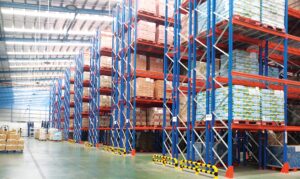
Warehouse layouts should be designed to facilitate one-way product flow — from the receiving area to the dispatch zone. Products that arrive first should be stored in easily accessible positions to ensure they are picked and shipped out first. Businesses can utilize storage solutions such as pallet flow racks or drive-in racks to optimize product movement and warehouse space efficiency.
- Labeling and Signage to Support FIFO Workflows
Clear and consistent labeling is essential for identifying product arrival dates, batch numbers, or expiry dates to support FIFO protocols. Labels should be highly visible and easy to read across all storage levels, while signage should guide warehouse staff to pick items in the correct order.
By optimizing warehouse design, including reorganizing storage space, strategically arranging products, and implementing it effectively, businesses can significantly enhance warehouse productivity, minimize the risk of product damage or long-term stock, and accelerate order fulfillment and delivery times.
Technologies Supporting FIFO
To execute FIFO efficiently and accurately, the adoption of warehouse technologies is crucial.
- Warehouse Management System (WMS)
A Warehouse Management System plays a central role in monitoring and controlling FIFO workflows. It records inbound and outbound transactions in real time, tracks receiving dates, expiry dates, and storage locations, and automatically recommends which batch should be picked first. Integrating barcoding or RFID tagging with WMS further automates FIFO enforcement, reduces human error, and improves inventory accuracy.
»» Read more: ASRS System
- Automated Picking & Pallet Flow Racks
Combining an automated picking system with pallet flow racking allows for continuous and sequential movement of products using the FIFO principle. These gravity racks allow new stock to be placed at the back, pushing older stock to the front for easy access and distribution.
»» Read more: Pallet Flow Racking

Challenges and Best Practices in FIFO Application
To ensure that this method operates smoothly and effectively, businesses must understand the common challenges that may arise and adopt the best practices to overcome them.
Common Issues with FIFO
- Managing Diverse SKUs
When a warehouse carries multiple SKUs, maintaining the correct in-out order becomes increasingly complex. Products of different sizes, shapes, or storage requirements must be sorted differently. Without a clear warehouse management system (WMS) or updated layout, employees may accidentally select newer items before older items, disrupting the FIFO process.
- Inefficient Inventory Rotation Process
If older inventory is not easily accessible, warehouse staff may inadvertently take new inventory before it is available, leading to a buildup of obsolete inventory. This not only increases the risk of waste, spoilage, and obsolescence, but also leads to financial loss due to unsold goods.
- Handling Exceptions and Damaged Stock
Managing exceptions such as damaged, returned, or recalled items can interrupt it workflows. These cases must be clearly identified and segregated from regular inventory to avoid confusion or contamination of stock data. Without a structured exception-handling process, damaged items may remain “stuck” in the system, disrupting inventory flow and affecting warehouse accuracy.
Tips to Overcome FIFO Challenges
To ensure FIFO (First In, First Out) operates effectively in practice, businesses must combine staff training, process standardization, and continuous monitoring. Maintaining consistency and discipline in warehouse operations is the key to maximizing the benefits of a this method system.
- Staff Training
Warehouse staff are the ones directly implementing FIFO principles on a daily basis. Therefore, regular training on inbound–outbound procedures, expiry date recognition, and product organization is essential. When employees clearly understand the objectives and importance of its, they are more likely to follow procedures proactively and minimize operational errors.
- Regular Audits and Process Improvements
Conducting internal audits on a regular basis helps identify deviations in stock rotation early. These evaluations make it possible to pinpoint process bottlenecks and implement appropriate improvements, such as optimizing warehouse layouts, updating SKU management systems, or applying automated FIFO tracking technologies.
FAQ about FIFO (First-In, First-Out)
FIFO (First-In, First-Out) is an inventory management method where the first products stored are also the first products retrieved or sold. This system helps maintain proper stock rotation and reduces product expiration risks.
FIFO is important because it improves inventory accuracy, reduces obsolete stock, minimises waste, and ensures older products are dispatched before newer inventory.
FIFO is widely used in food and beverage, pharmaceuticals, cold storage, retail, and manufacturing industries where product freshness and expiry control are critical.
Racking systems such as pallet flow racking, shuttle racking, carton flow systems, and drive-through racking are commonly used to support FIFO inventory management.
FIFO dispatches the oldest inventory first, while LIFO (Last-In, First-Out) retrieves the most recently stored products first. FIFO is preferred for perishable or time-sensitive goods.
FIFO improves efficiency by maintaining organised stock rotation, reducing product waste, improving picking accuracy, and supporting smoother inventory management.
Yes, FIFO is highly suitable for cold storage warehouses because it helps ensure temperature-sensitive and perishable goods are rotated correctly before expiry.
Yes, selective pallet racking can support FIFO because every pallet is directly accessible, allowing operators to retrieve older stock first.
FIFO helps food and beverage warehouses reduce spoilage, maintain product freshness, comply with safety regulations, and improve inventory traceability.
Pallet flow racking uses gravity rollers to move pallets from the loading side to the picking side, ensuring the first pallet loaded is the first pallet retrieved.
Challenges include warehouse layout planning, higher system costs for specialised racking, staff training, and maintaining accurate inventory tracking.
Yes, FIFO significantly reduces inventory waste by ensuring older stock is used or shipped before newer inventory arrives.
Yes, FIFO helps deliver fresher products, improves order accuracy, and reduces the risk of expired goods reaching customers.
Pallet flow racking is considered one of the best systems for FIFO operations because it automates stock rotation and improves picking efficiency.
Vinatech provides customised FIFO storage solutions, including pallet flow racking, shuttle systems, and warehouse layout design tailored to operational requirements and Australian standards.
Optimize FIFO Operations with Vinatech Australia
As a leading provider of smart storage and warehouse management solutions, Vinatech Australia partners with businesses to implement FIFO-based inventory management systems efficiently and professionally.
With extensive practical experience and a team of skilled technical experts, Vinatech delivers integrated solutions that combine modern racking systems with Warehouse Management Software (WMS). These solutions enable precise control over stock movement, minimize human error, and significantly boost warehouse performance and productivity.
𝐕𝐢𝐧𝐚𝐭𝐞𝐜𝐡 𝐀𝐮𝐬𝐭𝐫𝐚𝐥𝐢𝐚 – 𝐒𝐦𝐚𝐫𝐭 𝐖𝐚𝐫𝐞𝐡𝐨𝐮𝐬𝐞 𝐒𝐨𝐥𝐮𝐭𝐢𝐨𝐧𝐬
- Website: https://vinatech.com.au/
- Phone number: 0406 916 355
- Email: info@vinatech.com.au
- Address: 34 Paramount Bvd, Cranbourne West VIC 3977, Australia

My name is William Harris, and I am the Production Director at Vinatech Australia. I oversee the entire manufacturing operation for our industrial warehouse racking systems and the development of smart warehouse solutions.