
Good profit Margin is one of the most important financial indicators, reflecting how efficiently a business generates profit from its revenue. It helps managers, investors, and stakeholders assess a company’s profitability, operational efficiency, and overall financial health. Maintaining a stable profit margin not only ensures competitiveness but also lays the foundation for sustainable long-term growth.
What is Profit Margin?
Profit margin is an important metric that reflects a company’s profitability, indicating how much profit a business earns from each dollar of revenue generated. It is a core financial indicator in accounting and corporate finance, calculated by dividing net profit by total revenue or sales, after deducting all production, operating, tax, and interest expenses.
Beyond being just a financial figure, profit margin serves as a benchmark for assessing management efficiency and growth potential. A high profit margin indicates that the company operates efficiently, controls costs effectively, and optimizes resources, thereby generating more profit per unit of revenue.
Conversely, a low profit margin reveals limited profitability, which may result from selling prices being lower than production costs or rising operating expenses. This directly impacts the company’s competitiveness and long-term sustainability in the market.

Read more: Cost of Production: Key Costs & Calculation Guide
Types of profit margins
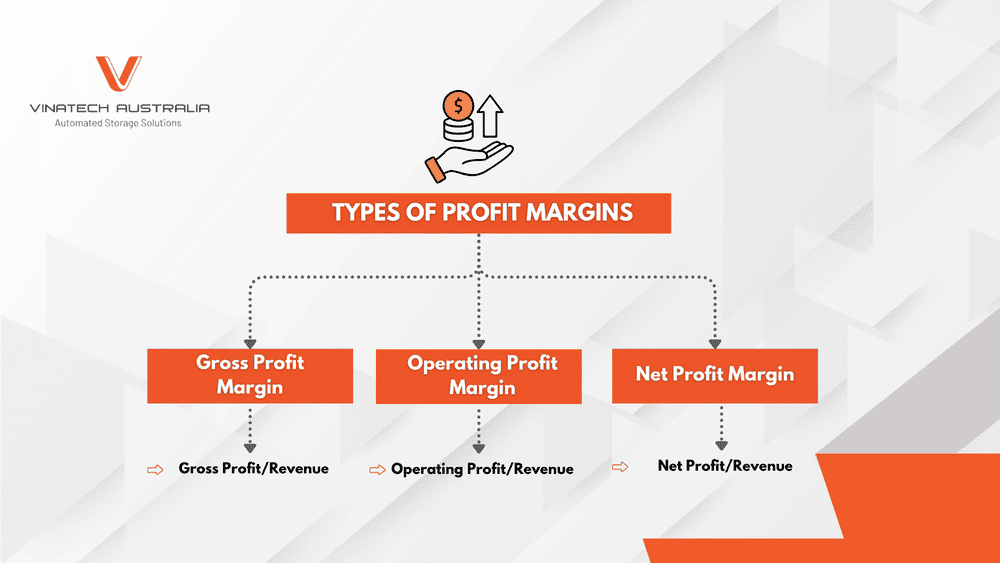
There are three main types of profit margins: gross profit margin, which shows profit after subtracting production costs; operating profit margin, which takes into account operating expenses; and net profit margin, which reflects the final profit after all expenses, taxes, and interest have been deducted. Together, these three indicators provide a comprehensive assessment of a company’s financial position and operational efficiency.
Gross Profit Margin
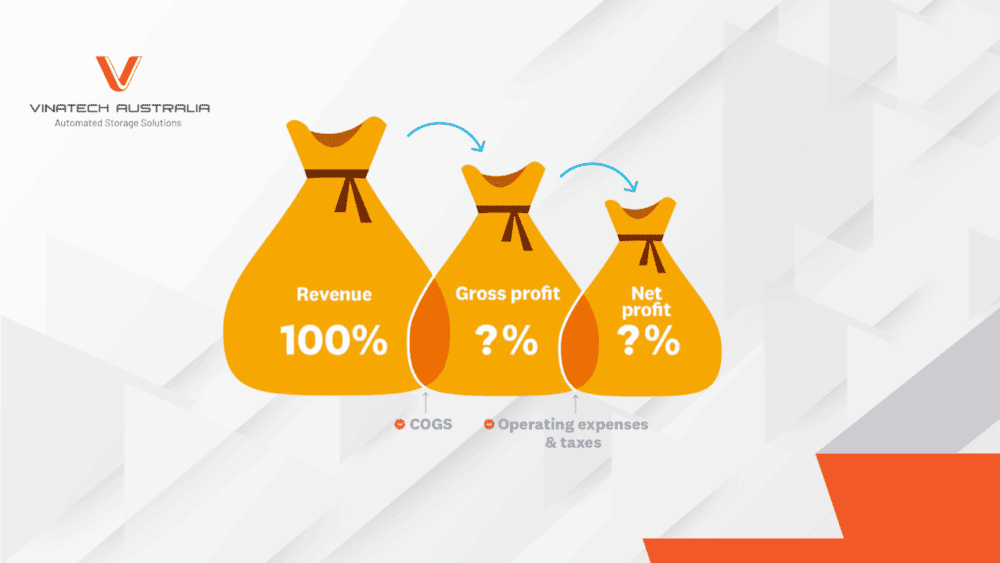
This represents the portion of profit a business earns after deducting the direct costs of producing goods or providing services, commonly referred to as the cost of goods sold (COGS). This is a key indicator used to evaluate a company’s production efficiency, cost management capabilities, and pricing strategy.
Formula:
Gross Profit Margin = (Revenue – Cost of Goods Sold) / Revenue × 100%
A high gross profit margin indicates that the company effectively controls production costs and applies an efficient pricing strategy. Conversely, a low margin may signal rising input costs or strong price competition in the market.
Operating Profit Margin
This measures the profit a business earns from its core operating activities after subtracting variable production and operating expenses such as wages, materials, utilities, and transportation — but before taxes and interest. It is an important indicator of how well a company manages costs, organizes production, and generates profit from its main business operations.
Formula:
Operating Profit Margin = Earnings Before Interest and Taxes (EBIT) / Revenue × 100%
Example: A company with an EBIT of 650 million VND and total revenue of 900 million VND would have an operating profit margin calculated as follows: 650,000,000 / 900,000,000 = 72.2%.
Net Profit Margin
This reflects the percentage of total revenue that remains as profit after all expenses, taxes, and interest have been deducted. This is one of the most important indicators of a company’s overall efficiency and financial health, as it clearly shows how much actual profit is generated from each unit of revenue.
Unlike the gross or operating profit margins, the net profit margin takes into account all types of expenses — including production, operational, financial, and tax costs — to present the company’s true profitability.
Formula:
Net Profit Margin = Net Profit After Tax / Revenue × 100%
Example: If Company A has a net profit after tax of 70 million VND and total revenue of 330 million VND, then its net profit margin is calculated as: 70,000,000 / 330,000,000 = 21.2%.
What is Considered a Good Profit Margin?
A good profit margin does not have a fixed number — it largely depends on the industry, cost structure, and market conditions in which a business operates. Understanding industry-specific benchmarks helps companies set realistic goals, evaluate their performance against competitors, and identify opportunities to improve profitability over the long term.
Profit Margin Benchmarks by Industry
This can vary significantly across industries due to differences in operating costs, business models, and pricing power. Some sectors achieve higher margins thanks to low fixed costs, digital scalability, or high-value products, while others operate with thinner margins because of labor intensity, high material costs, or strong market competition.
In Australia, according to IBISWorld statistics, the average profit margins across key industries are as follows:
| Industry | Average Profit Margin (%) | Key Factors Influencing Margins |
| Technology & Software | 20–30% | Low overhead, scalable digital services |
| Retail Trade | 3–8% | High competition, inventory and logistics costs |
| Manufacturing | 5–10% | High material and labor expenses |
| Construction | 3–6% | Cost volatility, competitive bidding |
These benchmarks help businesses assess their profitability relative to industry standards and identify whether improvements in pricing strategy, efficiency, or cost control could enhance their margins.
Factors That Influence Profit Margins
A company’s good profit margin is influenced by a combination of internal and external factors that determine how efficiently it can generate profit from its business operations. Understanding these factors helps businesses identify opportunities to enhance performance and maintain financial stability, even in highly competitive markets.
- Internal factors mainly relate to how a company manages its resources and operations. Effective cost control minimizes expenses while maintaining product or service quality. A well-structured pricing strategy helps balance competitiveness with profitability, while high labor productivity and operational efficiency reduce production costs per unit — ultimately improving profit margins.
- External factors are often beyond the company’s control. Fluctuations in market demand, changes in consumer preferences, and variations in raw material or energy prices can directly impact profitability. Rising competition or new market entrants can pressure companies to cut prices, shrinking profit margins. Macroeconomic factors like inflation, currency fluctuations, and supply chain disruptions also significantly affect business performance.
How to Improve Profit Margin
To improve this, businesses should focus on three key pillars: cost control, operational efficiency, and pricing strategy optimization. Balancing these factors not only boosts profitability but also builds a foundation for sustainable growth.
Effective Cost Control
Companies can start by regularly reviewing operational expenses, identifying and eliminating unnecessary subscriptions or services, and renegotiating with suppliers to secure better prices and terms. Additionally, managing labor costs smartly — through automation or workflow restructuring — can significantly reduce expenses while maintaining high productivity levels.
Enhancing Operational Efficiency
Operational efficiency is essential for maintaining stable profit margins over the long term. Standardizing workflows, adopting technology, and implementing lean production processes can reduce processing time and overhead costs. Moreover, improving customer service quality and fostering a culture of innovation among employees helps strengthen brand value and create sustainable competitive advantages.

Optimizing Pricing Strategy and Product Portfolio
Businesses should adopt a flexible pricing strategy that aligns with the true value of their products or services. When companies understand the value they deliver, they can confidently adjust prices to reflect superior quality and service, ensuring both customer satisfaction and stronger profitability.
Importance of Profit Margin for Sustainable Business Success
Maintaining a good profit margin is a core factor in ensuring a company’s long-term sustainability and growth. A stable and strong margin not only reflects effective management capabilities but also provides a solid financial foundation that allows businesses to adapt to market fluctuations, invest in expansion, and seize new growth opportunities.
A company with a good profit margin is often viewed as having a sound business model, consistent profitability, and strong long-term growth potential — making it easier to attract investment and scale operations. Moreover, good profit margin is a key indicator in financial reporting, helping managers assess the company’s health and make informed strategic decisions. When maintained at an optimal level, profit margin reflects not only financial efficiency but also the credibility and competitiveness of the business in the marketplace.
Vinatech Australia – Pallet Racking & Smart Warehouse Solutions
- Website: https://vinatech.com.au/
- Phone number: 0406 916 355
- Email: info@vinatech.com.au
- Address: 34 Paramount Bvd, Cranbourne West VIC 3977, Australia

My name is William Harris, and I am the Production Director at Vinatech Australia. I oversee the entire manufacturing operation for our industrial warehouse racking systems and the development of smart warehouse solutions.