


As product ranges grow, keeping inventory organised becomes more challenging. SKUs make it easier to identify products, track stock and manage warehouse operations. This guide explains what SKUs are, how they work and how they influence warehouse storage design.
What is a SKU?
SKU stands for Stock Keeping Unit. It is a unique code that businesses assign to a product or a specific product variation to identify and track it within their inventory system. Whether in a small retail store or a large distribution centre, SKUs provide a consistent way to distinguish products, monitor stock levels and keep inventory records organised.
The key characteristics of SKUs include:
- Unique Identification: Each SKU represents a specific product or product variation, such as a particular size, colour or packaging type.
- Internal Coding System: Businesses create and manage their own SKU codes based on their product range and inventory requirements.
- Inventory Tracking: SKUs support accurate stock monitoring by recording quantities, incoming deliveries and outgoing goods.
- Warehouse Management: When linked to storage locations, SKUs make it easier for warehouse staff to locate products, organise inventory and complete picking tasks.
Why are SKUs important for Inventory Management?
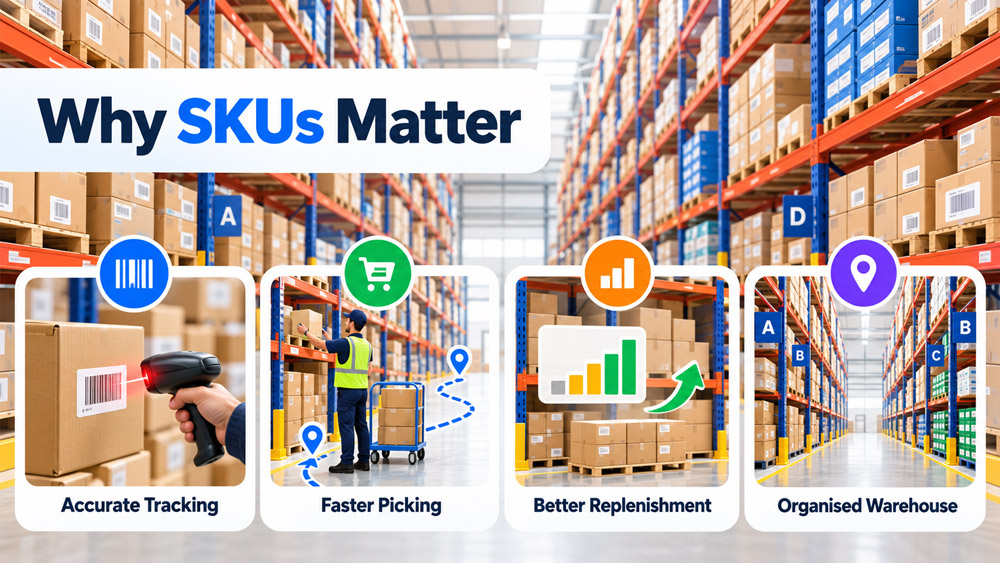
A consistent SKU system provides a common reference across purchasing, warehousing and sales. Everyone works with the same product identifiers, making inventory information easier to maintain and share between departments.
More accurate inventory tracking
SKUs allow businesses to monitor stock levels at the individual product-variation level rather than relying on broad product categories. Instead of simply knowing that 200 units of a particular product range are available, an inventory manager can identify exactly how many units remain in each size, colour or specification.
Faster order picking and fulfilment
SKU codes give warehouse staff a precise reference for identifying the required product. When integrated with a warehouse management system (WMS), they can also be linked to storage locations, allowing pickers to find the right stock without searching through similar items.
Better stock control and replenishment
SKU tracking gives inventory managers a clearer view of which products are moving quickly, which are selling slowly and where shortages might occur. This information can support purchasing decisions, replenishment schedules and the management of seasonal demand.
Improved warehouse organisation
SKU information becomes even more valuable when it’s used to organise physical inventory. Products can be grouped according to characteristics such as size, storage requirements, stock volume or movement frequency, allowing warehouse teams to create a layout that better reflects their daily workload.
For instance, fast-moving SKUs may be placed in easily accessible picking locations, while bulk quantities or slower-moving products can be stored in designated areas. This reduces unnecessary movement and makes it easier for staff to retrieve products when required.
How does SKU variety affect warehouse racking design?
The relationship between SKU management and warehouse storage becomes particularly important when a business is planning a new facility, expanding its operations or reviewing an existing layout.
High-SKU vs Low-SKU Warehouses
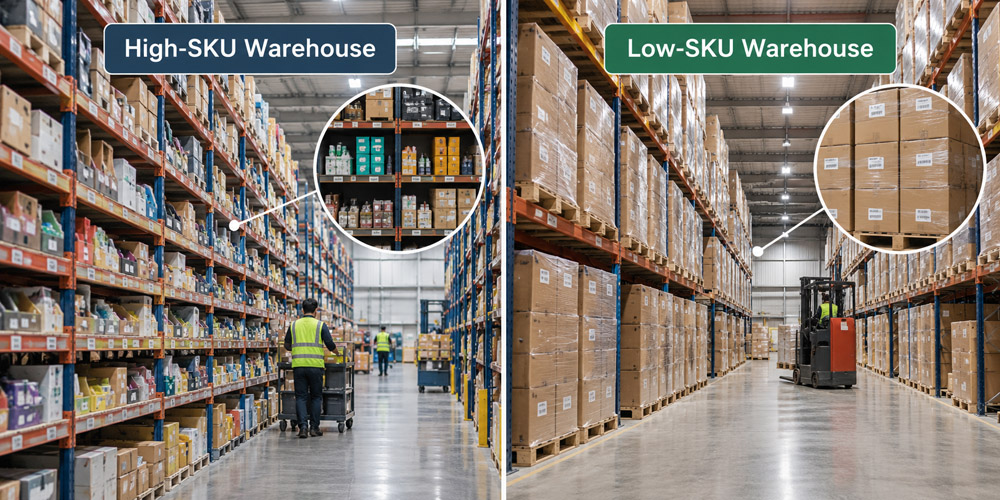
The number of SKUs a warehouse handles plays an important role in determining its storage requirements. However, it’s not just about product variety. The quantity of stock held for each SKU and how frequently it needs to be accessed also influence warehouse layout and racking selection.
Warehouses can generally be divided into two categories based on their SKU profiles:
- High-SKU Warehouses: Store a wide variety of products in smaller quantities, requiring frequent access to different items. Selective pallet racking is often suitable due to its direct pallet accessibility.
- Low-SKU Warehouses: Store fewer product types in larger quantities, making high-density systems such as drive-in racking or pallet shuttle systems practical for maximising storage space.
Neither warehouse type has a single ideal storage solution. The right racking configuration depends on balancing SKU variety, pallet quantities, storage density and accessibility to meet daily operational needs.
Choosing Racking Systems based on SKU Profiles
Different warehouse racking systems offer different advantages in terms of pallet accessibility, storage capacity and stock rotation. Understanding the number of SKUs and the quantities stored for each one can help businesses identify which options are worth considering.
The following table provides a general comparison:
| Warehouse Inventory Profile | Suitable Racking System | Why It May Work |
| High SKU variety with frequent individual pallet access | Selective Pallet Racking | Provides direct access to every pallet position |
| High SKU variety with limited floor space | VNA Racking | Maintains direct pallet access while reducing aisle space, subject to suitable handling equipment |
| Moderate SKU variety with several pallets per product | Double Deep Racking | Stores pallets two positions deep to improve density, with reduced access to rear pallets |
| Low SKU variety with large quantities of each product | Drive-in Racking | Uses deep storage lanes to accommodate multiple pallets of similar goods |
| High-volume products requiring FIFO rotation | Pallet Flow Racking | Supports first-in, first-out movement through separate loading and retrieval sides |
| Large, repetitive pallet quantities suited to dense storage | Pallet Shuttle Systems | Uses a shuttle to move pallets within deep storage lanes, reducing the need for forklifts to enter them |
Common SKU management mistakes to avoid
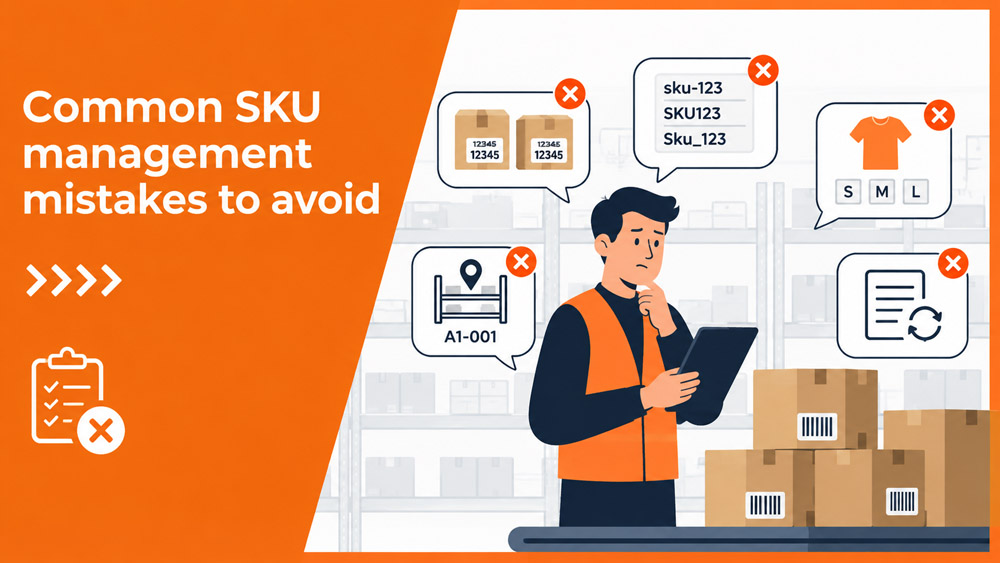
Even with a structured SKU system in place, inventory records can become difficult to manage if product codes aren’t maintained consistently. Some of the most common mistakes include:
- Using duplicate SKU codes: Assigning the same identifier to different products can create confusion during stocktakes, order picking and replenishment.
- Inconsistent naming conventions: Switching between different code formats makes products harder to recognise and inventory records more difficult to maintain.
- Missing product variations: Grouping different sizes, colours or packaging configurations under one SKU can hide important differences in stock availability.
- Mixing SKU codes with storage locations: Product identifiers should remain separate from rack or bin locations, as inventory may be relocated over time.
- Failing to update inventory records: Even a well-designed SKU system becomes unreliable when stock quantities and storage locations aren’t updated after inventory movements.
These issues can be avoided through consistent SKU coding, regular stock checks and clear warehouse procedures, with coding rules reviewed as product ranges expand.
FAQs About SKUs
Is a SKU the same as a barcode?
No. A SKU is an internal product identifier, while a barcode is a machine-readable representation of data. A barcode can encode a SKU or another identifier, such as a GTIN. Businesses often use both together to identify products and record inventory movements.
Can two different products have the same SKU?
Within the same inventory system, different products should have different SKU codes to avoid confusion. However, two separate businesses may use identical SKU codes because each company creates and manages its own internal identification system.
How many SKUs should a business have?
There’s no ideal number of SKUs for every business. The total depends on how many distinct products and variations need to be tracked. A small retailer may manage a few hundred SKUs, while a large distribution centre could handle thousands or more.
Can the same SKU be stored in multiple warehouse locations?
Yes. A single SKU can be stored across several racks, aisles or warehouse zones, depending on stock volume and operational needs. A warehouse management system can record the quantities held at each location, allowing staff to find and retrieve inventory accurately.
Does SKU count affect warehouse racking selection?
Yes, but SKU count is only one part of the decision. Warehouses handling many different products often benefit from racking systems that provide direct pallet access, while those storing large quantities of fewer SKUs may be suited to higher-density storage. Stock turnover, pallet quantities and handling requirements should also be considered.
Vinatech Australia: Industrial Warehouse Racking – Warehouse Shelving Solutions
🌐 Website: https://vinatech.com.au/
☎️ Phone number: 0485 083 868
📩 Email: info@vinatech.com.au
📌 Address: 34 Paramount Bvd, Cranbourne West VIC 3977, Australia

William Harris is the Production Director at Vinatech Australia, with more than 10 years of experience in industrial warehouse racking, manufacturing, warehouse optimisation and smart storage technologies. His professional background combines engineering, production management and warehouse operations, enabling him to oversee the development of storage systems designed for safety, durability, efficiency and long-term operational performance.