

Pallet racking relocation involves more than dismantling racks and moving them to another location. From structural safety and warehouse layout to relocation costs and operational downtime, every stage needs careful planning. This guide explores the relocation process, Australian safety requirements and the key considerations for making better use of warehouse storage space.
1. What is Pallet Racking Relocation?
Pallet racking relocation is the process of dismantling, moving and reinstalling an existing pallet racking system, either within the same warehouse or at a different facility. It allows businesses to reuse suitable storage equipment when relocating, expanding or reorganising their warehouse operations.
Businesses typically consider pallet racking relocation in several situations:
- Warehouse Relocation: Moving an existing racking system to a new facility while retaining suitable components.
- Warehouse Reconfiguration: Rearranging rack positions or storage zones to improve accessibility, capacity or material flow.
- Warehouse Expansion: Relocating or extending existing storage systems to accommodate additional inventory.
- Operational Changes: Adjusting the warehouse layout to support new products, handling equipment or distribution requirements.
Regardless of the reason, the process needs to begin with a proper assessment of the existing system and the proposed installation site. Racking that performs well in its original location may require modifications before it can be safely installed elsewhere, particularly when warehouse dimensions, floor conditions or operational requirements have changed.

>> Read More:
- Pallet Racking Audits & Safety Inspections In Australia
- How to Maximise Warehouse Space: Racking, Layout and Inventory Strategies
2. Can Existing Pallet Racking be relocated and reused?
Many pallet racking systems can be relocated and reused, provided their components remain in suitable condition and the new installation meets the relevant engineering and safety requirements.
Assess the condition of Existing Racking
Before relocation, the existing racking should be inspected by a competent person to identify damage, wear or other conditions that could affect its structural performance. Forklift impacts, overloaded beams and damaged connections are common concerns, especially in busy warehouses where pallets are moved frequently.
The inspection should cover upright frames, beams, bracing, connectors, base plates and other structural components. Signs of corrosion, permanent deformation or previous unauthorised modifications also require attention, as even relatively minor damage can affect the performance of a loaded rack.

Check compatibility with the New Warehouse
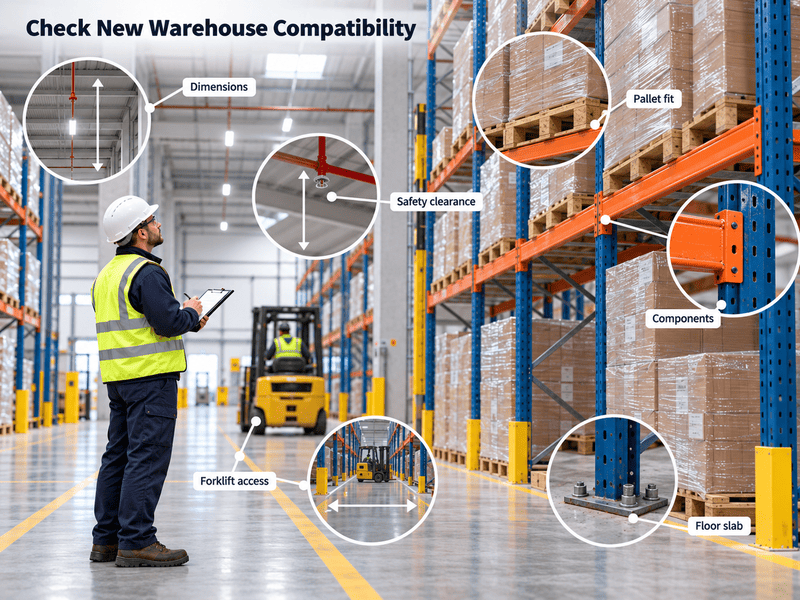
A racking system that remains in good condition may still be unsuitable for the proposed warehouse. Several factors should be assessed before finalising the relocation plan:
- Warehouse Dimensions: Available floor space, ceiling height, building columns and access points must accommodate the proposed rack configuration.
- Floor Slab Conditions: The new floor must be assessed for the loads transferred through the rack uprights and anchors.
- Forklift Access: Aisle widths, turning space and operating clearances must suit the material-handling equipment.
- Pallet Specifications: Pallet dimensions, load weights and storage requirements must remain compatible with the racking design.
- Component Compatibility: Beams, uprights, connectors and replacement parts must be suitable for use together.
- Safety Clearances: Fire protection systems, pedestrian routes, emergency exits and operational access must be considered.
Reviewing these conditions early helps identify whether the original system can be reused as planned or whether a revised layout, replacement components or an alternative racking configuration would be more appropriate.
3. How does the Pallet Racking Relocation process work?
A successful pallet racking relocation starts well before the first beam is removed. The process involves several connected stages, from evaluating the existing installation to confirming that the relocated system is suitable for use at its new location.
Step 1: Site Survey and Relocation Planning
The process begins with a survey of both warehouses to assess racking conditions, available space and layout requirements. Key factors include floor conditions, pallet specifications and forklift access. A relocation plan is then developed to coordinate stock movements, equipment and installation schedules.
Step 2: Racking Inspection and Safe Dismantling
Before dismantling, all pallets must be removed and the work area secured. A competent inspection identifies damaged components and determines their suitability for reuse. Qualified personnel then dismantle the racking following manufacturer instructions and appropriate safety procedures.
Step 3: Component Labelling and Transportation
Dismantled components are labelled and organised by type, size and installation position. Beams, upright frames and accessories are secured for transportation to prevent damage or loss. Proper handling and identification also make reinstallation easier.
Step 4: Racking Reinstallation and Layout Adjustment
The racking is reassembled according to the approved design, with attention to alignment, anchoring and safety clearances. Layout adjustments may improve storage capacity and forklift access, but any configuration changes require appropriate technical assessment.
Step 5: Final Inspection and Handover
A competent person inspects the relocated racking to verify structural stability, anchoring and load capacity before use. Technical documents and load signs are updated where necessary. Once all safety checks are completed and outstanding issues resolved, the system is ready for handover.

4. Pallet Racking Relocation Safety and Australian Standards
For Australian warehouses, these risks need to be considered alongside the applicable Australian Standards and workplace health and safety requirements.
The Australian Standard for steel storage racking was revised in 2023 and is divided into two parts, covering different aspects of racking design and operation.
- AS 4084.1:2023 – Steel Storage Racking, Part 1: Design: Covers structural design, analysis and testing requirements for racking within its defined scope.
- AS 4084.2:2023 – Steel Storage Racking, Part 2: Operation and Maintenance: Addresses installation, operation, inspection and maintenance requirements for systems within its scope.
These standards are particularly relevant to adjustable static steel pallet racking. Specialised systems, including drive-in and cantilever racking, may fall outside their defined scope and require consideration of other applicable design requirements.
WorkSafe Victoria advises that pallet racking should be installed, operated and maintained in accordance with manufacturer instructions and AS 4084.2:2023. Changes to rack configurations or components should also be reviewed by the original supplier, manufacturer, designer or another suitably competent person.

5. Relocate, Reconfigure or Replace: Which is the better option?
Moving to a new warehouse creates an opportunity to review the existing storage system rather than automatically transferring every rack to the new location.
The decision generally comes down to three options: relocating the existing system, reconfiguring suitable components or replacing equipment that no longer meets operational needs.
| Option | When it may be suitable | Main consideration |
| Relocate | Existing racks remain in good condition and suit the new warehouse layout | Structural suitability, installation conditions and relocation costs |
| Reconfigure | The existing equipment can be reused, but the layout needs to change | Engineering assessment, component compatibility and revised load ratings |
| Replace or Upgrade | Existing racks are damaged, unsuitable or unable to meet future storage requirements | New equipment costs, storage capacity and long-term operational needs |
A comparison of all three options helps businesses avoid decisions based solely on short-term relocation costs. Structural suitability, storage capacity, operating requirements and expected growth should be considered together.
>> Read More:
- Pallet Racking Accessories: Small Parts, Big Impact
- Warehouse Management: Make Every Metre and Movement Count
6. Why warehouse relocation is an opportunity to improve storage design
Relocation provides a useful opportunity to reassess these requirements and plan the storage area around current operations rather than carrying forward an outdated configuration. An updated warehouse layout may offer several advantages:
- Increase Usable Pallet Positions: Make better use of available floor space and building height without compromising required access or safety clearances.
- Improve Forklift Access: Provide suitable aisle widths, turning space and traffic routes for the handling equipment in use.
- Reduce Unnecessary Pallet Movements: Position inventory according to handling frequency and retrieval requirements.
- Support Different Inventory Profiles: Select storage systems suited to high-SKU operations, bulk inventory or products with specific stock rotation requirements.
- Allow for Future Expansion: Consider expected inventory growth when determining the layout and storage configuration.
The most practical layout balances capacity with the time and effort required to store, access and move products throughout the facility. Reviewing these factors during relocation can help avoid transferring existing inefficiencies into a new warehouse.
Explore Vinatech’s industrial storage solutions for your warehouse layout and handling requirements.
Vinatech Australia provides warehouse design and layout planning services, including site assessments and 2D and 3D layout development. These capabilities support the evaluation of different storage configurations before a business commits to a new racking installation.